Space
- Planets
Something’s cooking on Saturn’s moon
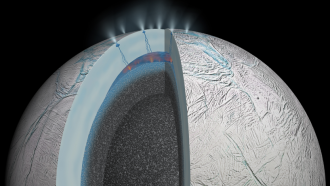
Grit in one of Saturn’s rings likely formed in hot water on the planet’s ice-covered moon Enceladus. That suggests conditions on this moon might be able to support life.
- Physics
Galaxy cluster creates ‘magnifying glass’ in space
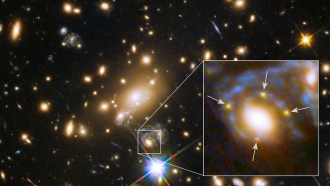
A massive galaxy’s gravity is so strong that it bends light, creating a “lens” in space. This natural magnifying glass is giving astronomers a rare view of a supernova on the other side of the universe.
- Space
Astronomers spy fastest speeding star
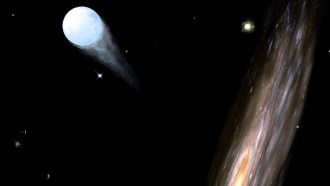
A few stars have been spotted departing our galaxy. The fastest of these might have been propelled by another exploding star, a new study finds.
- Physics
Dust erases evidence of primordial gravity waves
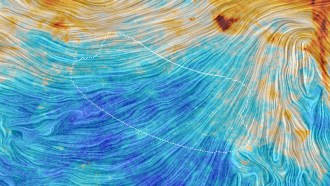
In March 2014, scientists claimed to have found the first echoes of the Big Bang — ripples in the very fabric of space. A new analysis shows the experts were mistaken. Dust appears to explain the confusion.
- Space
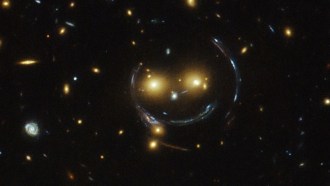
Picture This: Smiley face in space!
Ancients used to ‘see’ the outline of animals and other well-known things as constellations in the night sky. Now astronomers have done much the same thing. But they’ve spotted a more distant — if totally modern — shape: a smiley face!
- Physics
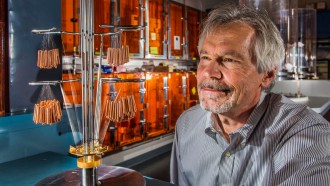
Machine simulates the sun’s core
A machine heats iron atoms to temperatures that match the interior of the sun. This has helped solve a solar mystery.
- Space
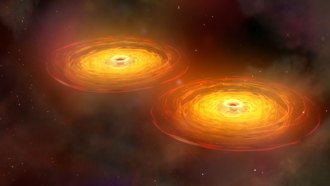
Black holes are on collision course
But be patient. The distant galactic smashup is still some million years away.
- Chemistry
Asteroid impacts may have sparked life on Earth
The energy produced by comets and asteroids that collide with Earth may have been strong enough to start life.
- Physics
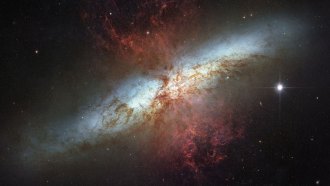
Light robs galaxy of star-making gas
Stars form from clouds of hydrogen and other gases. Astronomers have found the light from newborn stars can drive off that gas. That action can starve a galaxy of the ingredients needed to make more stars.
- Earth
Earth’s most common mineral finally gets a name
A half-century search for samples of Earth’s most abundant mineral has ended. This stuff forms only deep in the rocky layer surrounding our planet’s core. But scientists found bits of it in a meteorite that fell in 1879. And finally, this bridgmanite gets a name.
- Planets
Comet probe may shed light on Earth’s past
Scientists spent more than two decades setting up Philae’s months-long investigation of a comet. What they hope to learn could shed light on Earth’s childhood — and the source of its water. But that’s if problems with Philae’s landing don’t cut the robot’s life span.
- Planets
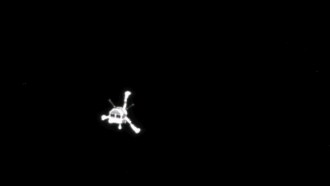
Picture This: Falling to a comet
After a more than decade-long ride, a robotic lander has left its spacecraft and floated down onto the surface of a comet. From there it should begin scouting for hints at how our solar system formed.