Space
- Planets
Super-earths not a place for plate tectonics
Plate tectonics build big mountain ranges on Earth. But super-Earths would be too big for such movements to occur, a study finds.
- Planets
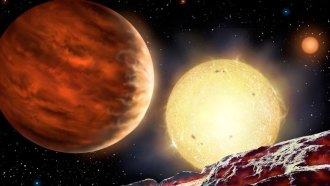
Teen finds exoplanet
Tom Wagg discovered exoplanet WASP-142b while doing an internship. Just 15 at the time, he is possibly the youngest person ever to find an exoplanet.
- Planets
Cosmic collision may have given birth to Pluto’s moons
Hubble Space Telescope photos reveal that the Pluto family may have formed from debris left behind after something slammed into the dwarf planet.
- Space
News Brief: Surprise — comet lander awoke!
Scientists think the lander’s instruments may have lots to share about comet 67P/Churyumov-Gerasimenko in coming days to weeks.
- Earth
Asteroids boiled young Earth’s oceans
At least two asteroids hit Earth 3.3 billion years ago. This superheated the atmosphere, boiled the oceans and shaped how early life evolved.
- Space
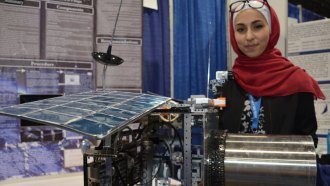
Collecting trash in space
Space junk threatens satellites that cost millions of dollars. But one teen has come up with an idea to collect and dispose of that orbiting trash.
- Brain
Trip to Mars could damage astronauts’ brains
Experiments in mice suggest the high-energy particles that would zap astronauts on a mission to Mars could leave the explorers with brain damage.
- Climate
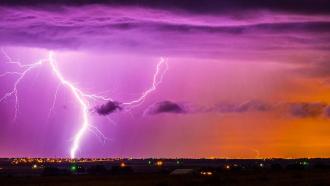
Cosmic rays offer clues about lightning
Space particles called cosmic rays pelt Earth. Scientists are using the rain of these particles to probe how lightning forms.
- Space
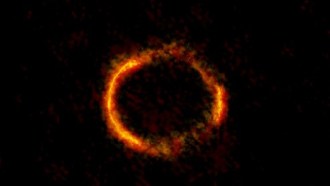
Scientists Say: Gravitational lens
A gravitational lens is an effect that occurs when a massive object lies between a viewer and something further away. The massive object’s gravity bends light arriving from the more distant object.
- Space
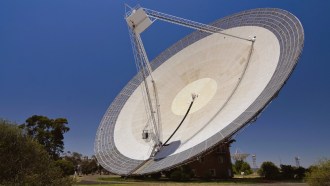
Radio telescope picks up signals from intelligent life
Astronomers tracked down the source of perytons, mysterious radio bursts. They had at first seemed to emanate from Earth’s atmosphere. Probing now suggests the life forms responsible had a penchant for leftovers.
- Planets
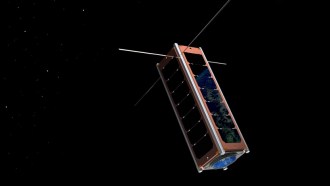
Mini-sats: The trick to spying Earth-bound asteroids?
NASA is supposed to begin nonstop screening by 2020 for all asteroids that could pose a threat to Earth. Some astronomers now think the only way to affordably meet that deadline is by using mini-satellites
- Materials Science
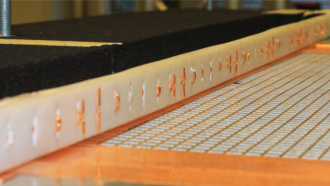
New mirror picky in what it reflects
A new type of mirror is selective in the light it reflects. It allows some wavelengths of radiation to pass through, while others bounce off.