Questions for ‘These ultra-long experiments outlive their scientists — on purpose’ 
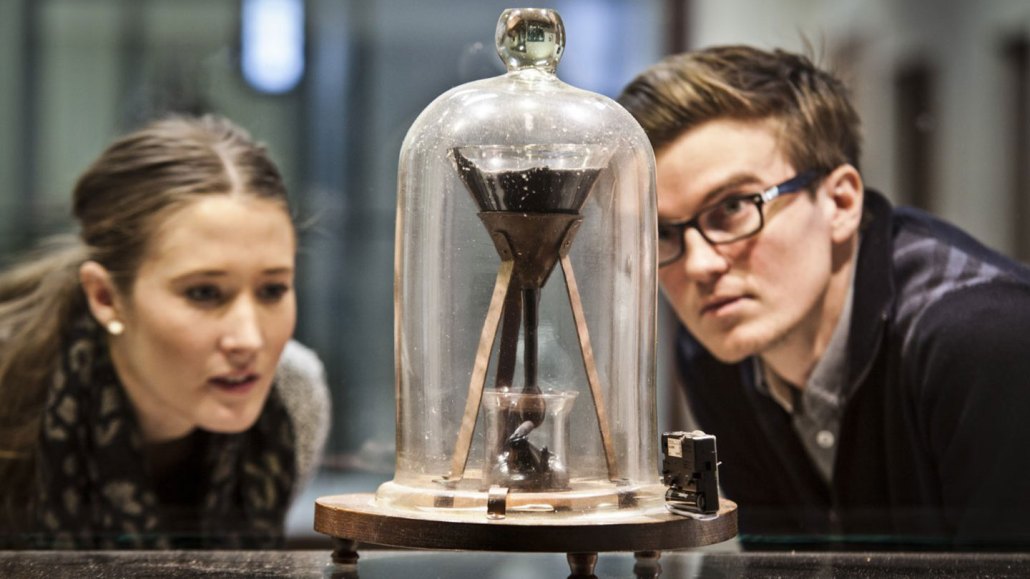
a man and a woman are staring intently at a funnel of pitch under a glass case

This is the longest-running laboratory experiment in the world. In 1927, a physicist in Australia wanted to see how often pitch, the sticky stuff used to pave roads, would form droplets. Since then, only nine drops have fallen. No one has ever seen one fall.

The University of Queensland

To accompany These ultra-long experiments outlive their scientists — on purpose’

SCIENCE

Before Reading:

  1. Imagine setting up an experiment that would answer an important question: Are we alone in the universe? But there’s a caveat. The experiment will take 100 years to complete — so you likely won’t know the findings. During the planning stage, a colleague asks you how you feel about putting in the energy to set up this experiment, considering the long duration of the study. How would you respond?
  2. What is one field of science that you think might benefit from very long-duration experiments? Explain your answer. Approximately how long would an experiment in this field have to be for you to consider it a long-duration experiment?

During Reading:

  1. In what year did William James Beal stash 20 bottles at a secret location? What did the bottles contain?
  2. What question did Beal hope to answer with his bottles?
  3. What year did the Voyager mission begin? What was the planned duration for the mission? How long has it run so far?
  4. What question was Thomas Parnell trying to answer when he set up his 1927 experiment?
  5. How long is the described log decay study intended to run? In what year is it planned to finish?
  6. What is one way a dead log helps other organisms in its ecosystem?
  7. Review the log decay studies described in this story and give examples of two different mechanisms by which wood might break down over time.
  8. What does it mean in an ecological study to establish a “baseline”?
  9. What very long-term effect is Pamela Templer’s team studying? How did the team simulate effects of this change in a shorter time period?
  10. In the Beal Seed Experiment, researchers began extending the time between bottle collections. Why did they make this change?

After Reading:

  1. Some of the experiments described in this story combine short-term and long-term goals. Consider the Voyager mission, for example. What is one example of a shorter-term goal (such as five years or less) of the Voyager mission? Consider how the goals of this mission changed over time, with short-term goals becoming long-term ones. If scientists had designed this mission with only the long-term goal in mind, and no shorter ones, do you think this would increase, decrease or not affect the motivations of the scientists working on the mission? Explain your answer.
  2. Describe two challenges of ultra-long experiments. Give an example of one of these challenges from the studies described in this story. What is one change that scientists could make, either in the setup or follow-through of such a study, that would address this kind of problem? Briefly explain your answer.