Is it possible to be invisible?
Humans would need superpowers, but some animals have real-life ways to be see-through

Fantastic Four’s Invisible Woman can vanish with ease. No real humans can pull off this feat — but some animals come close.
CAPITAL PICTURES/ALAMY
This is a human-written story voiced by AI. Got feedback? Take our survey . (See our AI policy here .)
In The Incredibles, Violet Parr is a lot like other teenagers. She has embarrassing parents, a troublesome little brother and a crush so intense it makes her want to disappear. But unlike other teens, Violet can turn invisible. So she can actually vanish when the boy she likes looks her way.
Characters with invisibility powers — like Violet, the Fantastic Four’s Invisible Woman and H.G. Wells’ Invisible Man — can do all sorts of cool things. Escape embarrassing situations. Snoop on other people. Get into places where they’re not allowed. It’s no wonder why invisibility is one of the powers kids most wish for. Many animals, too, find it helpful to hide in plain sight. And though it’s out of reach for people, some animals are nearly transparent.
Being invisible is useful for animals that spend a lot of time in places with no good hiding spots, like the air or open ocean, says Kate Feller. She studies vision and behavior at Union College in Schenectady, N.Y.
The secret to invisibility is all about light. “The way we see things is when light is reflected back off of an object onto our eyes,” says Feller. The more light that can pass through something undisturbed, the harder it is to see that thing.
Light can’t easily pass through most animals, Feller says. Light that hits our bodies usually gets absorbed or bounced around. But animals with nearly invisible body parts have figured out tricks to get around this.
Cutting out color
A lot of animals get their colors from molecules called pigments. These compounds appear different colors depending on which wavelengths of light they absorb and which they reflect. Green pigments, for instance, reflect green light and absorb all other colors. Human hair and skin get color from the pigment melanin. For an animal to vanish in plain sight, it needs to get rid of these colorful compounds.
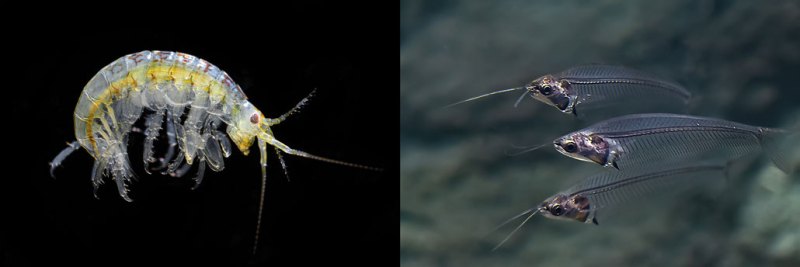
Most baby fish lack pigments. This helps them hide from predators when they are too small to swim fast. They typically develop pigments as they grow up. Yet some species stay see-through their whole lives. One is the ghost catfish (Kryptopterus vitreolus). Its head has pigments, but its body is almost fully transparent. Seen from far away, it looks like a floating head!
Some body parts are hard to hide. Eyes need pigments that absorb light so an animal can see. And even clear stomachs will show up if animals eat colorful food. Ghost catfish eat only small bits of food and “hide” their meals in a long, thin, tube-shaped stomach, says Qibin Zhao. This physicist and material scientist studies ghost catfish at Shanghai Jiao Tong University in China.
Blood can’t be transparent, either. The molecules that carry oxygen have colored compounds. (The one in our blood, hemoglobin, makes it red.) So up close, the ghost catfish’s vessels are still visible.
Glass frogs have a clever way around this. When these mostly clear frogs sleep, they cram almost 90 percent of their blood cells into their liver. This makes their belly skin two to three times more transparent than it would otherwise be. Scientists think the frogs do this so that predators don’t snack on them while they nap.
Stopping light from bouncing around
Even pigment-free objects are not entirely invisible. Light travels at different speeds through different materials. As a result, light zipping through one material will bend or bounce when it hits another material. Light bouncing off an animal makes it shine, just like the sun reflecting off a puddle.
Some animals’ see-through parts are nearly reflection-free. Glasswing butterflies, for instance, have wings that are almost fully transparent. Their wings have fewer reflective scales than other butterflies’ wings. The wings are also covered in tiny wax bumps. These bumps soften light’s transition from air to tissue, allowing it to pass through the wing mostly undisturbed.
Tiny amphipod crustaceans do a similar thing, says Feller. These animals are so transparent you could read text right through their bodies. Their shells are covered with little round bacteria. These may create a smoother path for light, like the wax bumps on glasswing butterflies.
Even when light makes its way inside the body, an animal isn’t necessarily in the clear. Each cell in the body is full of many components that bend light as it passes through. Light then scatters around the body, making things look foggy.
The more tissue that light needs to pass through, the foggier things get, says Zhao. That’s why most invisible animals are pretty thin. Ghost catfish are only some 2 to 3 millimeters (about one-tenth of an inch) thin. See-through amphipods, a tiny crustacean, are similarly thin.
These animals also use other tricks to help their tissues scatter less light. “It’s about having fewer opportunities for light to do anything other than pass through it,” says Feller.
Muscles pose a particular challenge. They have lots of little structures that are great at scattering light.
Transparent shrimp have muscles with large myofibrils. These are the bundles of proteins that make muscles contract. Having fewer bundles that are very large, rather than a bunch of small myofibrils, results in fewer surfaces to scatter light.
Ghost catfish use a similar strategy. Their muscles are made of large flat plates stacked on top of each other, instead of the little round fibers most fish have. This design gives light fewer chances to bend and bounce around.
Now you see me
In theory, we could draw on the same tricks to vanish: Don’t let light bounce around in your body. The Invisible Man in H.G. Wells’ story was a physicist who studied light refraction. He became invisible by changing how much his body bent light.
But that would be hard for a person — or any land animal — to do in real life. Animals are mostly water, Zhao says. Light doesn’t bend that much when passing from water into a sea creature. But going from air into an animal’s body, it bends a lot — making invisibility much harder on land.
So, disappearing might sound tempting next time your crush looks your way. But in the real world, you’re probably better off just talking to them.