How hot can our planet get? Earth’s climate history holds clues
A tour through Earth’s past suggests how life will survive global warming — or not
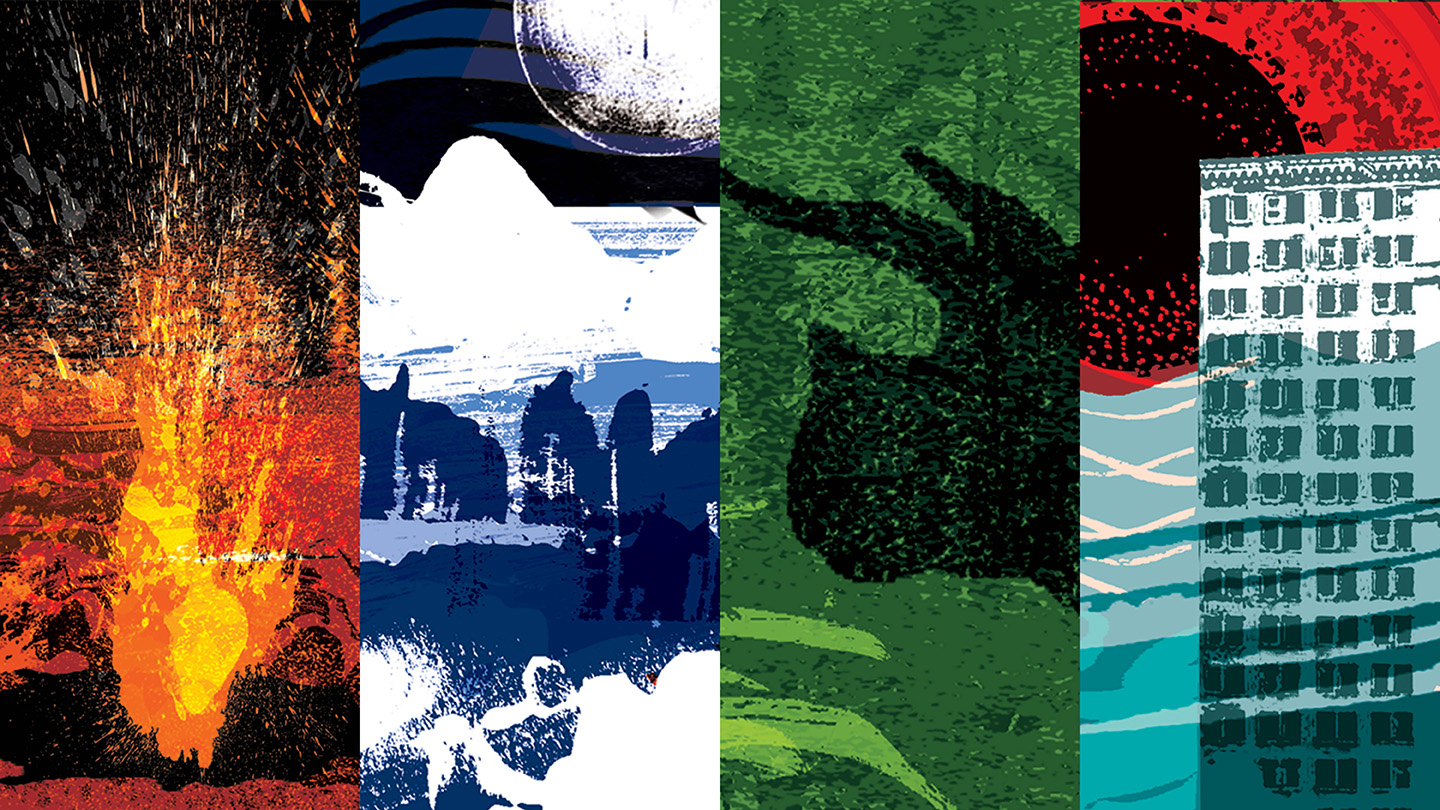
Earth’s climate has changed again and again over its more than 4-billion-year history. Humans will determine the next phase of climate change.
Andy Lovell
This is a human-written story voiced by AI. Got feedback? Take our survey . (See our AI policy here .)
As a species, humans like it cold.
Even now, we live in an “ice age.” Though the term may bring to mind saber-toothed cats and woolly mammoths, such ages are defined by ice caps at the poles. And for most of its 4.6-billion-year history, our planet was too warm — sometimes far too warm — for polar ice.
For more eons than not, Earth has ranged from steamy to downright hellish.
A look back at Earth’s history shows us how fragile and fleeting our current moment is. Between its fiery infancy and its (for now) chilly present, Earth’s climate has taken many forms.
Learning why Earth’s climate changed in the past — and what happened to life when it did — can help us understand where we are today. We know our species evolved in the cold. Yet human-caused warming has set our planet onto a hot new path.
What can the past teach us about where we might be headed?
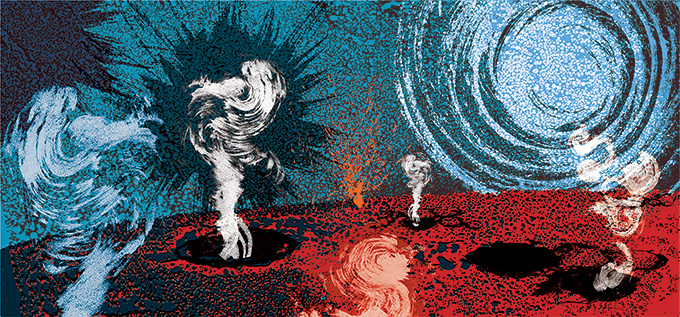
Hadean Eon: Hell on Earth
Earth’s turbulent infancy began some 4.6 billion years ago. Clumps of material formed out of the disk of hot dust and gas that swirled around the young sun.
About 100 million years later, a Mars-sized rock called Theia smacked into the young Earth. That run-in released the energy equivalent of trillions of hydrogen bombs. It was enough “to pretty much vaporize most of Theia and melt what becomes the Earth,” says Norman Sleep. He’s a planetary scientist at Stanford University in California.
That collision left the planet a hellish ocean of magma beneath a sky of rock vapor. Weak sunlight beat down on a cracked crust of black-gray basalt. In the sky hung a second ball of glowing magma: the moon. This orb had formed from the impact debris, maybe in just a few hours.
This was the Hadean Eon — the hottest Earth has ever been. Over the next 1,000 years, Earth cooled somewhat. Rock vapor in the atmosphere would have condensed and fallen — think showers of lava or perhaps flakes of rocky snow.
The magma ocean solidified more slowly. The young moon heated Earth via the force of its gravity. This kneaded Earth’s interior and kept the planet molten for perhaps tens of millions of years.
Finally, that magma ocean crystallized into rock.
This marked a turning point for our planet, Sleep says. The sun became its most important source of energy. Ever since, Earth’s climate has been driven by how much solar energy it gets, reflects and retains.
Archean Eon: Earth’s thermostat turns on
The Archean Eon stretched from 4 billion to 2.5 billion years ago. It began when Earth’s surface cooled enough to form solid rock. Back then, the young sun was only about 70 to 80 percent as bright as it is today. Its energy alone would not have been enough to keep the planet as warm as it was.
In theory, Earth should have cooled enough to ice over. But it didn’t. Why?
As the Earth cooled, it produced a thick, steamy atmosphere. Water vapor fell as rain. A lot of rain. It poured until Earth’s surface drowned beneath a global ocean once more — this time, of water.
The cooling planet also released greenhouse gases such as carbon dioxide (CO2) and methane. These acted like a blanket to trap heat around Earth. “There was a bigger greenhouse effect” than today, says David Catling. A planetary scientist, he works at the University of Washington in Seattle.
At around the same time, another major change kicked in: the carbon cycle. This acts as the planet’s natural thermostat.
Here’s how it works. Through the greenhouse effect, CO2 in the atmosphere warms Earth’s surface. A process called chemical weathering traps some of that CO2 in minerals called carbonates. They can stay trapped in rocks for a long time. Over hundreds of thousands of years, however, the movements of Earth’s tectonic plates recycle Earth’s surface into its interior.
In Earth’s mantle, the carbonates break down. Their carbon then gets belched back up by volcanoes as CO2. Back in the air, it once again warms the planet.
This cycle is sensitive to temperature: Chemical weathering speeds up in warm climates and slows in cold ones. The overall effect helps keep temps fairly stable.
By the early Archean, the carbon cycle had locked away enough CO2 to bring temps into a range habitable for life. Modeling studies suggest the planet ranged between a frosty zero degrees and a toasty 40° Celsius (32° to 104° Fahrenheit). In fact, the earliest signs of life date to this period.
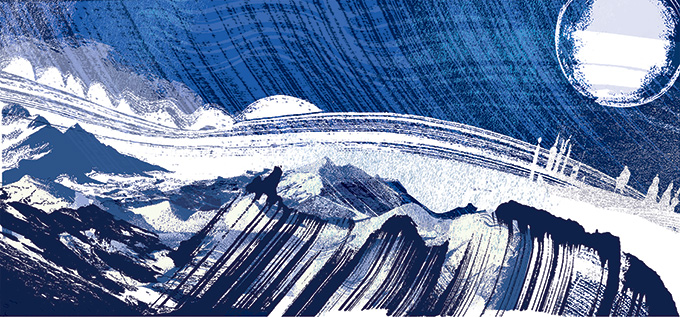
Snowball Earth: A deep freeze
Between 2.4 billion and 2.1 billion years ago, Earth froze over. Thick sheets of ice encased the planet from pole to equator. Temperatures may have plummeted to as low as -50 °C (-58 °F) and stayed low for tens of millions of years.
This deep freeze was one of several icy episodes called Snowball Earths. They bookend the otherwise toasty Proterozoic (PRO-tur-eh-ZOH-ik) Eon. It stretched from 2.5 billion to 541 million years ago.
The ice sheets grew through a runaway feedback loop. Sparkling white ice reflects more sunlight than does land or water. That lowers temperatures, which encourages even more ice to form. Once polar ice creeps past a latitude of about 30° North or South, the planet will become a snowball.
“Once you reach that tipping point in the area of sea ice, then it takes on the order of 200 or 300 years to reach the fully [iced-over] state,” says field geologist Paul Hoffman of the University of Victoria in Canada. “That’s pretty quick on a geological time scale.”
Glacial rock deposits that formed at the equator are evidence that the Snowballs happened. But how they started remains a mystery. One theory blames biology.
Clues from ancient rocks suggest the Proterozoic oceans bloomed with photosynthetic organisms. They would have released lots of oxygen into the air. Oxygen breaks down methane. So it ate away the methane blanket that had kept Earth warm for 1.5 billion years.
The carbon cycle wouldn’t have been able to keep up, Catling says. Eventually, “you could grow ice sheets and make a Snowball Earth.”
Earth’s thermostat won’t let a Snowball go on forever. As the land freezes over, chemical weathering shuts down. But volcanoes don’t. They keep pumping CO2 into the atmosphere. Eventually, the greenhouse effect will thaw out the planet. As that ice melts, the planet will reflect less sunlight. The bonus energy will warm the planet even more. Suddenly, the ice retreats.
Do you have a science question? We can help!
Submit your question here, and we might answer it an upcoming issue of Science News Explores
Permian Period: Warming and mass extinction
Today, ice persists at Earth’s poles. These “icehouse” periods are few and far between in Earth’s history.
The last one was in the early Permian Period. This was about 300 million years ago. The average temperature was probably 15 degrees C (27 degrees F) cooler than today. Earth might have looked a bit like it did 20,000 years ago. That’s when woolly mammoths roamed Europe.
This cold spell lasted for 105 million years. Then climate change transformed the land into a scorched — and possibly toxic — wasteland.
Over some 20 million years, things started getting less friendly to life, says Neil Tabor. He’s a geologist at Southern Methodist University in Dallas, Texas. Why? In part this was thanks to the assembly of the supercontinent Pangaea. As more land crammed together, coastlines shrunk and sea levels dropped. Coastal areas dried out, and throughout the parched continental interior, temperatures swung wildly.
485 million years of temperature swings
Earth has experienced both hot and cold periods over time, though warm times have been more common. That’s true of the last 485 million years, as seen in this timeline reported in 2024. Our genus, Homo, evolved nearly 3 million years ago during a rare cold spell.

Then huge volcanoes in what’s now Siberia started erupting. They didn’t stop for 1 million years.
Over that time, they spewed enough lava to bury an area as large as the continental United States under 50 meters (160 feet) of molten rock! With all that lava came lots and lots more CO2. And that made surface temperatures soar.
In a geologic blink — perhaps as quickly as 60,000 years — average temps jumped as much as 10 degrees C (18 degrees F), reaching around 30 °C (90 °F). Oceans sweltered and grew too sluggish to circulate oxygen. Much marine life suffocated.
Bacteria that thrived in the oxygen-deprived depths poisoned the water with hydrogen sulfide. That deadly gas might have bubbled up to poison the land, too. Volcanic gas mixed with water to rain acid on the barren, dusty wastes.
On land, there were “toxic, salty, shallow acid lakes,” says Kathleen Benison. “And lots of windblown, red dust.” A geologist, Benison studies the Permian climate. She works at West Virginia University in Morgantown.
Near the end of the Permian, some 252 million years ago, Pangaea was a sunbaked, dusty wasteland. Daytime air temperatures in the tropics hovered around 50 °C (122 °F). On the hottest days, they climbed to 73 °C (163 °F) — hot enough to destroy proteins. Any living thing that couldn’t flee to the poles would have been cooked alive.
The resulting mass extinction was the worst our planet has ever seen. In a few hundred thousand years, 70 percent of species on land disappeared. The seas were hit even harder: 95 percent of marine species died out.
It may have taken millions of years for life to recover.
The Permian offers a cautionary tale for our current moment.
“We’re still technically in an icehouse, but we’re rapidly going towards a greenhouse,” Benison says. “Looking back at the [end of the Permian] is a good way to try to say what happens with these big changes. And not just what happens with climate, but what happens to life.”
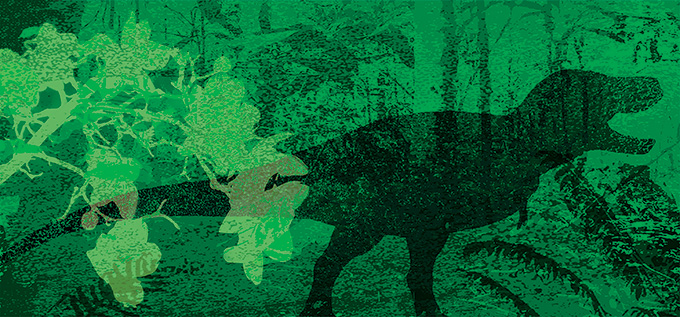
Cretaceous Period: Gradual heat
A greenhouse doesn’t always lead to mass extinctions, though. By 90 million years ago in the Cretaceous Period, the planet was a lush jungle world. Vast swaths of the continents were flooded by shallow seas. In some areas, carnivorous dinosaurs like Spinosaurus prowled the shores. At 36 °C (97 °F), Earth’s average surface temps hovered around human body temperature. Even polar seawater was a soupy 27 °C (81 °F).
Despite that, this period saw “no mass extinction,” says Brian Huber. He’s a geologist at the Smithsonian National Museum of Natural History in Washington, D.C.
Huber was part of a team that charted Earth’s surface temps for the last 485 million years. This timeline revealed a super-hot greenhouse environment. In fact, it was the hottest Earth has ever been since the evolution of any life more complex than a microbe.
Scientists aren’t sure what drove temperatures so high. But it’s clear that the rise was fairly gradual.
There was no 10-degree jump like the one that rocked the Permian. Instead, Earth had been hot for a long time. In fact, it never really cooled down after the Permian extinction. Average surface temps worldwide mostly stayed above 20 °C (68 °F). (For comparison, that’s just 5 degrees C [9 degrees F] hotter than it was in 2024.) And the poles were largely ice-free throughout the dinosaurs’ nearly 180-million-year reign.
So perhaps the Permian extinction was so massive because of the swing from icehouse to greenhouse. An abrupt change may have put ecosystems under additional stress. That would be bad news, considering what’s happening today.
What’s next for Earth’s climate?
Following a 50-million-year cooling, we’re now in an icehouse period.
The time 55 million years ago was known as the Paleocene-Eocene Thermal Maximum, or PETM. It was the hottest period in the history of our Earth — that planet with the continents and ecosystems we know today.
Atmospheric CO2 levels were high, and temps reached an average of up to 34 °C (93 °F). Unlike us, creatures that lived back then were used to an iceless planet. There was no mass extinction, but ecosystems shifted. And many species died out in parts of their ranges. Some disappeared completely.
Since the PETM, Earth has been cooling down. This could be due in large part to the rise of the Himalayan mountain range in Asia. Chemical weathering of all that fresh rock could have driven steady drops in atmospheric CO2. By 34 million years ago, Antarctica was cold enough for year-round ice. And by 800,000 years ago, CO2 levels fell below about 300 parts per million (ppm).
But in just the past 200 years, human activities have driven airborne CO2 levels back up. Emissions — such as from coal-fired power plants and gas-fueled cars — have nearly doubled CO2 levels, from 280 ppm to 426 ppm. Average temperatures have ticked up by 1.47 degrees C (2.65 degrees F).
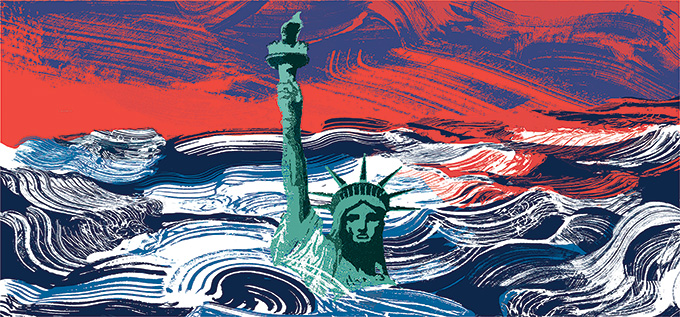
If nothing major changes in our approach to climate change, this will be just the beginning. By 2100, CO2 levels could reach 600 ppm. Some climate models show it could soar above 1,000 ppm. That could result in average temperatures 4 degrees C (7 degrees F) warmer than in preindustrial times.
If we’d been around in the PETM, we’d have had to migrate to the poles to survive. That’s bad news for today’s humans. Cities can’t exactly get up and move. By the end of this century, billions of people will routinely face heat and humidity extremes beyond the limits of human survival.
The next glacial period will start later than expected, if at all. And by 2500, four-tenths of all land will have become unsuitable for its current biome, scientists predict.
This glimpse of a likely future is informed by our past. And it gives us the chance to choose a different path. Cutting carbon emissions can still slow warming and its impacts.
If extreme warming occurs, it would end the world as we know it. But it would not be the end of the world.
Even if we trigger a climate catastrophe on the scale of the Permian mass extinction, Earth’s history shows that the planet will recover and life will eventually thrive again. The carbon thermostat will correct our error — but it is very slow. We can’t wait millions of years for it to fix climate change for us.