Farting fish and tooting manatees — how some animals use gas
Flatulence can be used to float in the sea or find fishy friends
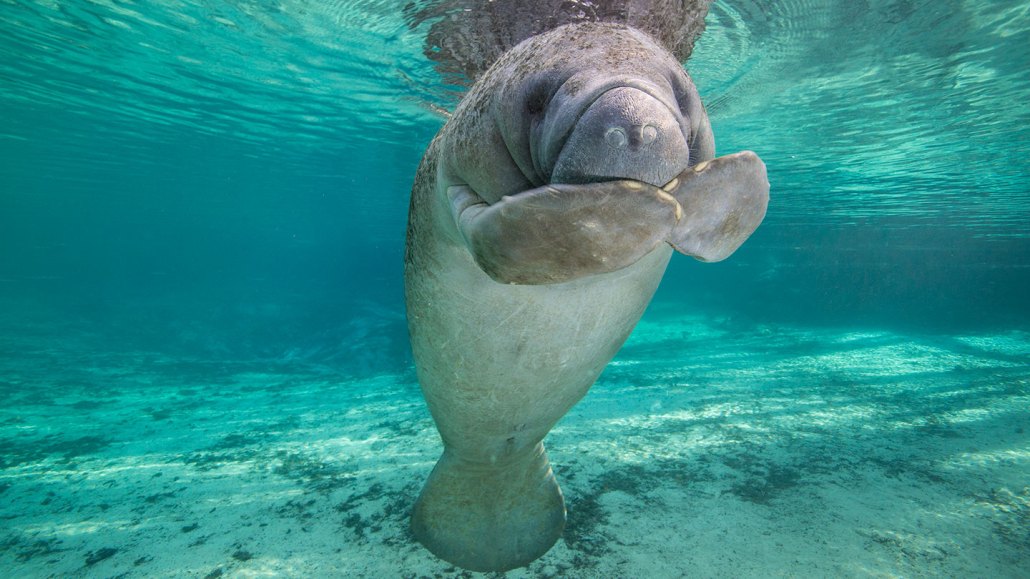
“Did I do that?” Florida manatees store gas in their guts to help them float — and may release some to dive.
Gregory Sweeney/Moment/Getty Images
Humans aren’t the only animals who fart. Take Dakota, an English cocker spaniel. When she was getting older, she could no longer hold in her gas, says Em Finke, Dakota’s former human. “She would start farting during a nap, jolt herself awake and then do several panic laps of the kitchen island,” farting the whole time.
Dakota’s gas got way worse when she ate rawhide, her favorite treat. “She generated the most foul gas I’ve ever smelled,” says Topher Hunter, Dakota’s other former human. He likened it to “a corpse that had been left in the sun on a compost heap.”
Even the old dog herself noticed. “She’d make this sad face every time she farted,” Hunter recalls.

Humans might think of farts as funny or gross. We’re less likely to think them useful or important. Sure, they can send a message — especially if you let one go in someone’s face. But farts are just gas — a little hello from the microbes in your gut.
Some animals have found a role for their flatulence. In people, a fart is a release of gas from the anus, that opening we poop out of. Manatees, a marine mammal, have a similar setup. But in their aquatic lifestyle, those farts can prove a benefit.
Nick Caruso is a data scientist and an author of the book Does it Fart?: The Definitive Field Guide to Animal Flatulence. Florida manatees (Trichechus manatus) can store air in their guts, he notes. “The gas can originate from either swallowed air or be a byproduct of digestion.” Gas is less dense than water. So more gas in the gut makes these critters more buoyant, he notes. For manatees, having more gas inside means they can float more easily.
Their diaphragm — the muscle that controls breathing — is extremely strong. The animals also have very strong abdominals, or stomach muscles. Manatees can use those powerful muscles to compress gas in their intestines, spurting some out — farting — when they want to dive deeper.
Manatees get a lot of this gas from grass. They eat mainly seagrass as they swim through Florida’s shallow waters. These plants are tough to digest. Manatees rely on a very large hindgut to break down this food. That gut — and the microbes in it — produce a lot of gas.
Do you have a science question? We can help!
Submit your question here, and we might answer it an upcoming issue of Science News Explores
Butt bubbles
Not every animal has an anus, notes Dani Rabaiotti. “There are lots of other types of openings involved,” she says. A zoologist at Nattergal, a nature restoration company with headquarters in Norwich, England, she co-authored Does It Fart?
Birds, sharks, reptiles, amphibians and some fish have a cloaca, an all-purpose out-hole for wastes and reproduction. Most mammals separate urine and feces. Animals with cloacas, however, send both out together from a single channel.
And sometimes, they use the hole for gas.
The sand tiger shark (Carcharias taurus) has been known to fart, says David Shiffman. He’s a marine conservation biologist and author of the book Why Sharks Matter: A Deep Dive with the World’s Most Misunderstood Predator. The shark, he says, isn’t farting because of food. It’s farting to float.
Most bony fish have swim bladders that help them float. Sharks and rays lack bones — and swim bladders. Sharks do have very oily livers. Oil is lighter than water, so it helps them stay in the water column, Shiffman explains. But even then, many sharks “are constantly swimming,” he says, so they don’t sink.
The sand tiger shark doesn’t always swim, he says, “they sometimes more hover in the water column.” The animal will gulp air at the surface of the ocean and then use it to help them hover. “That air has to exit somehow, and they have been observed expelling air through their cloaca,” Shiffman says.
Not everything passing through cloacas bubbles out. “There are also animals that breathe through their bum,” Rabaiotti explains. Some species of turtles, for example, can pump water into their cloaca. Oxygen in the water enters their blood. When in water, Australia’s white-throated snapping turtle (Elseya albagula) gets 48 percent of its oxygen this way.
What goes in, of course, must then go out. “The air being expelled looks a lot like a fart,” Rabaiotti says. “But technically [it] isn’t really, as it doesn’t come from the digestive system.”

Herring hellos
Herring also produce not-quite farts, notes Brittnie Spriel. She’s a marine ecologist at the University of Victoria in British Columbia, Canada. “They are expelling air through their anal duct,” she says. The fish gulp air at the surface to fill their swim bladders. This keeps them afloat. Later, they squeeze some of it out the other end.
The forced air is called a fast repetitive tick, or FRT (sadly, it’s pronounced EFF-aar-tee, not FART). It does, however, sound much like a fart.
The Swedish Navy was the first to hear fish FRTs back in the 1980s. It was surveying parts of the North Atlantic with hydrophones — devices that detect sound in water. At first, the sounds seemed like they might be coming from Russian submarines. But scientists soon realized they were actually listening to herring (Clupea pallasii and Clupea harengus).
For these fish, an FRT is just a way to find friends. “Herring mostly produce sounds at night,” Spriel says. This led scientists to hypothesize that FRTs are produced “to maintain cohesion during schooling behavior at night, when herring are less able to see each other.”
Spriel and her colleagues are continuing to study FRTs. They want to understand where herring go, how they behave — and how the many sounds we put into the ocean might make FRTs a little harder to hear.