Burps and farts: Why the body is such a gas
Studying the gas we pass helps scientists learn more about our health

Everybody passes gas. We all burp out of our mouths, and fart out the other end. Scientists are investigating what causes all this gas — and what it can teach us about our health.
Ocskaymark/iStock/Getty Images Plus
One recent morning, as I was getting ready for the day, I carefully snapped a small sensor to my underwear — right under my butt. Then I worked out, did a full day at my job and hung out with friends.
Meanwhile, the tiny sensor in my pants was tracking every single time I farted.
The sensor was from Brantley Hall. He’s a microbiologist at the University of Maryland in College Park. He developed a fart sensor to understand just how much people fart in a day. I was now part of his study — one of the thousands contributing to the Human Flatus Atlas.
I’ll admit I was nervous. Every time I ate something, I wondered if the sensor would later pick up a fart from it. I cringed every time I did fart. Do I fart too much? Not enough? What is the right amount anyway? And if we fart so often, why do we know so little about it?
Everybody farts, of course. Like many species, humans expel gas in the form of both burps (scientifically called belching or eructation) and farts (called flatulence or flatus). Both describe gas coming out of the body.
Why we burp is different from why we fart. And while people find farting and burping funny, we also tend to be embarrassed by doing either in public.
Instead of feeling ashamed, we should be curious.
And many scientists are. They’re studying our gassiness to figure out what it has to say about our health — and what we can do to keep passing gas in the right amounts.
You are a doughnut
The GI tract (short for gastrointestinal tract) passes from your mouth at one end of your torso to your anus at the other. It’s made up of a series of organs that help you process food, turn it into energy and get rid of wastes.
Together, these organs form one really long tube. The whole tract can be more than 9 meters (30 feet) long — the length of a school bus.

The tube starts at your mouth. Take a bite from a cookie, chew and swallow. That cookie now enters a muscular tube. Called the esophagus, it squeezes the cookie down toward a sphincter, a ring of muscle. This sphincter serves as the gateway to your stomach.
In the stomach, a digestive fluid called bile helps break down the cookie into a slurry.
This will pass through another sphincter and into the small intestine. There, any nutrients in it may get absorbed into the bloodstream. What’s left continues into the large intestine, or colon, where it begins its transformation into poop (and which hopefully looks nothing like the cookie you ate).
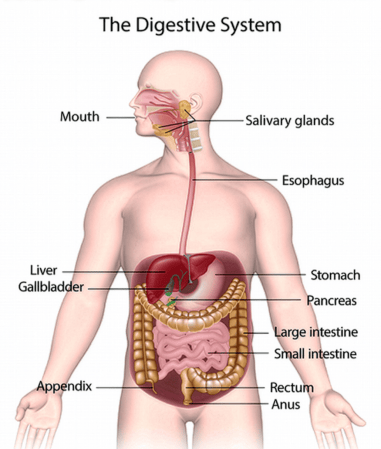
Our gastrointestinal system is one continuous tube that runs from the mouth at one end to the anus at the other end of the torso. But the many loops of intestine mean that the whole tract is actually far longer than the length of your torso.
In a way, this whole GI tract is outside of the body, says Brennan Spiegel. He’s a gastroenterologist — someone who treats GI problems — at Cedars-Sinai Medical Center in Los Angeles, Calif.
“Our body is kind of like a doughnut,” he says. That makes the GI tract a long doughnut hole.
“Our body has a hole that starts in our mouth and comes out the bottom. And it’s one hole that goes all the way through us,” Spiegel explains. Throughout this trek, he says, “You’re never, ever inside your body. You’re still outside your body the entire time.”
Being “outside” means this tube is exposed to air. And if air can get in, it can also get back out.
Born to belch
Whether the gas coming out is a burp or a fart depends on which end of the GI tract releases it. The tract is often divided into upper and lower sections. The upper portion extends from the mouth to the small intestine. The large intestine, rectum and anus make up the lower part.
There are also plenty of sphincters that separate one part of the gut from another. So depending on where gas is in the gut, it can leave different ways.
Gas coming from the stomach or higher will head out of the mouth. That’s a burp or a belch. People burp a lot — an average of 33 times per day.
There are two main types. Many burps develop when gas forms in the stomach. This is the burp you get from drinking carbonated drinks, such as soda, Spiegel explains. Some of that carbon dioxide gas will “basically come up through the sphincter,” he notes, as a gastric burp.
The second type is called supragastric. It means before the stomach. And it’s “where you do, in fact, swallow air,” says Spiegel. Called aerophagia (Air-oh-FAAHJ-ee-uh), this gulping of air sends it down the esophagus. Then someone forces it back up as a burp.
Fated to fart
When gas forms in the small intestine, large intestine, colon or rectum, it heads out the other end.
Usually, you sense the need to fart as pressure building up in your butt. But how do you know it’s not just an impending need to poop? A recto-anal inhibitory reflex, or RAIR, alerts us. When pressure fills the rectum, nerves there send a signal to the brain. RAIR lets you know whether you can sneak out a fart — or if you need to head for the restroom.
The internet might tell you that if you hold in a fart long enough, it will travel up and come out as a burp. But to come out the mouth, it would have to move backward through the intestines, stomach and more. That’s “30-plus feet of tubing,” Spiegel says. Because all that tubing is pushing food (and gas) toward the rectum, no fart has a chance of changing course.
Microbes make most of a fart’s gas, explains Cait Welsh. She studies our community of one-celled GI companions — known as our gut microbiome — at Monash University in Clayton, Australia.
“A lot of the food that we eat as part of our diet ends up in our lower intestine, our large intestine,” she says. That’s also where most of our gut bacteria live. “They essentially break down that food and ferment it.” (Fermentation is a process by which microbes break down carbohydrates into smaller molecules.)
Our gut microbes’ main job is not to make us let one rip in front of our friends. (That’s just a side benefit.) These bacteria ferment fiber, such as cellulose and pectins, from the plant-based foods we eat. On their own, our bodies can’t digest this fiber. We don’t need these substances for energy. Still, fiber helps us: It keeps food moving through our digestive tract and provides food for bacteria.
As these bacteria ferment fiber, they produce various gases. “They’re making carbon dioxide, just like we do,” says Thomas Schmidt. He’s a microbiologist — someone who studies one-celled life — at the University of Michigan in Ann Arbor. “Carbon dioxide (CO2), hydrogen, methane: all made by microbes in the colon,” he says.
And if you’ve eaten a lot of certain foods, such as broccoli, some microbes can produce hydrogen sulfide. It smells like rotten eggs.
Some of this gas crosses from the intestines into our blood. Eventually that blood will deliver the gas to the lungs, where you’ll then breathe it out. (Don’t worry, this is usually CO2 and hydrogen. So your breath won’t smell like a fart.)
Hydrogen produced by microbes fuels the growth of other microbes. But there’s always some left over. “Something like 20 to 40 percent of a given fart” is hydrogen, Schmidt says.
Everyone’s farts are going to be a bit different. And the recipe of our flatus can vary between people — and even in the same person over time. Why? Everyone has a different community of gut microbes. So they’ll break down different foods in different ways, producing different farts. Our microbiome can also morph over time. As those cells vary, so can the gases they produce.
For example, about 25 to 40 percent of people have gut microbes that produce methane, notes Karsten Zengler. He’s a microbiologist at the University of California, San Diego. “That’s why some people can light their farts and others cannot.”
But hydrogen gas is also very flammable, so in theory any fart could catch fire. And no, you should not try this!

Getting to know your gas
Scientists still have lots to learn about our flatus — such as whether measuring farts and what’s in them will share important things about our health.
When scientists study gut microbes, it’s usually in the lab, Zengler says. “You measure, in theory, the gas they make,” he says. But this won’t exactly match what happens in the human gut. Microbes there are in their own ecosystem. They’re feeding, interacting with each other and squirting out their little gases. These eventually become part of our farts.
Lately, researchers have started figuring out how changes in gut microbiomes might be linked to disease — and how those changes might be detectable from farts.
Welsh has studied the gut microbiomes of healthy people and people with a painful inflammatory bowel disease called Crohn’s. Healthy people have a lot of hydrogen-producing bacteria. People with Crohn’s disease do not, Welsh and her team reported in 2025 in Nature Microbiology. So the farts of Crohn’s patients might also show telltale hydrogen differences, she says.
Other diseases might cause problems with farting itself.
Remember how our GI tract is a hose? “If the garden hose is kinked and not folded correctly, then the water will get backed up and won’t go through the hose,” says Spiegel at Cedars-Sinai in Los Angeles.
If there’s a block somewhere in our gut, gas may not be able to get through. Luckily, “we don’t explode,” he says. Instead, parts of the GI system stretch. This creates a bloated sensation. People who feel that way for a very long time could have gut problems.
That’s why it could be very useful to understand how much people fart, what the farts are made of and what that tells us about our gut bacteria.
Upstream hints
Doctors can actually measure some of what’s in a fart from our breath.
When bacteria produce hydrogen or methane, some of that gas will diffuse into the blood. It will end up in the lungs, Schmidt says. Doctors can then measure these gases in a person’s breath. Afterward, they’ll give the person something to eat that will make their bacteria produce lots of hydrogen or methane — and then test their breath again.

“You can measure both hydrogen and methane in that breath sample,” he says.
It’s one way people can learn if they can’t digest lactose — a sugar in milk. Doctors give someone a dose of lactose to drink, wait for it to reach the intestines and then measure how much hydrogen that person exhales.
This test won’t tell you exactly how much of a gas is in the gut (or a fart). It also doesn’t capture everything. Still, it’s far easier to measure a breath than a fart, says Hall at Maryland. That’s why scientists have been able to give a confident answer about how many times someone burps daily.
Until recently, the only way to count farts directly was to stick a tube up your rear end. Yes, that’s uncomfortable. People also can’t go to work or school that way. So scientists have had no accurate way to identify what level of farting is normal.
That’s why Hall’s group invented that fart sensor, which I got to try out. The small round button attaches to the inside of your underwear and senses hydrogen.
Do you have a science question? We can help!
Submit your question here, and we might answer it an upcoming issue of Science News Explores
One test using the sensors found that people pass gas an average of 32 times per day. But rates varied — a lot. Some people farted just four times per day. Others passed so much gas they farted 59 times a day. Hall’s team shared its findings in December 2025 in the journal Biosensors and Bioelectronics: X.
When I attached the sensor to my underwear, I thought that maybe I was at the high end. I like eating a lot of fiber, so I figured my microbes must be pretty active.
But after three days, my sensor registered between 20 and 30 farts per day, some big and some very tiny. I’m a totally typical farter.
Hall hopes to use these sensors to get a better idea of how much people fart and what that might say about different gut diseases. They’re not only accurate, they also wouldn’t be affected by someone’s potential embarrassment.
People are often ashamed about their gas. “They might say, ‘I feel bloated,’” Hall says, “because they don’t want to talk about farting.” Eventually, knowing how much gas people pass will tell doctors about those microbes inside us — and what we should do to keep our burps and farts flowing.
Fun Facts

Do babies need help burping?
Babies can swallow air when feeding, so many parents pat them on the back to help them burp that air back out. This is to ensure the swallowed air doesn’t make the baby uncomfortable. But a 2014 study showed burping a baby didn’t make any difference in whether they spit up or cry.
Can you burp in space?
Yes, but it’s going to be chunky. Burping depends on gravity holding down your food as the gas comes back up. If there’s very little gravity — as in space — the gas and food won’t separate. So you can burp, but you’d better grab a barf bag.


Do babies fart in the womb?
Probably not, Karsten Zengler says. Farts need bacteria in the gut getting food, and fetuses gets all their nutrition through direct exchange to their bloodstream (across the placenta). Any gas they made would probably go out the same way, through their blood.