bat: A type of winged mammal comprising more than 1,400 separate species — or one in every four known species of mammal.
biologist: A scientist involved in the study of living things.
disperse: To spread, often widely. Plants, for example, disperse their seeds to far off sites by allowing them to ride the winds or survive being eaten by animals that travel great distances.
dolphins: A highly intelligent group of marine mammals that belong to the toothed-whale family. Members of this group include orcas (killer whales), pilot whales and bottlenose dolphins.
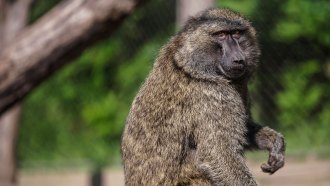
mammal: An animal distinguished by possessing hair or fur, the secretion of milk by females for the feeding of their young, and (typically) the bearing of live young. They also are warm-blooded (or endothermic).
marine: Having to do with the ocean world or environment.
marine mammal: Any of many types of mammals that spend most of its life in the ocean environment. These include whales and dolphins, walruses and sea lions, seals and sea otters, manatees and dugongs — even polar bears.
marsupial: A type of mammal that carries its young for a period after birth in external pouches. There the developing babies have access to their mother’s nipples — and milk. Most of these species evolved in Australian and have especially long hind-legs. Examples of marsupials include kangaroos, opossums and koalas.
native: Associated with a particular location; native plants and animals have been found in a particular location since recorded history began. These species also tend to have developed within a region, occurring there naturally (not because they were planted or moved there by people). Most are particularly well adapted to their environment.
nitrogen: A colorless, odorless and nonreactive gaseous element that forms about 78 percent of Earth's atmosphere. Its scientific symbol is N. Nitrogen is released in the form of nitrogen oxides as fossil fuels burn. It comes in two stable forms. Both have 14 protons in the nucleus. But one has 14 neutrons in that nucleus; the other has 15. For that difference, they are known, respectively, as nitrogen-14 and nitrogen-15 (or 14N and 15N). Nitrogen is also an important nutrient for living things. It shows up as a primary component of many animal wastes and of farm fertilizers.
nutrient: A vitamin, mineral, fat, carbohydrate or protein that a plant, animal or other organism requires as part of its food in order to survive.
platypus: Sometimes known as the duckbill, this shy Australian egg-laying mammal (Ornithorhynchus anatinus) has a streamlined body and flat bill. Its waterproof fur allows it to comfortably navigate in rivers and other waterways, where it feeds on invertebrate animals that live in the sediment. It uses electrical signals given off by the muscles of its prey to find its food. Males have a spur on the inner side of each ankle releases venom for use in their defense.
species: A group of similar organisms capable of producing offspring that can survive and reproduce.
trait: A characteristic feature of something. (in genetics) A quality or characteristic that can be inherited.
vertebrate: The group of animals with a brain, two eyes, and a stiff nerve cord or backbone running down the back. This group includes amphibians, reptiles, birds, mammals and most fish.
whale: A common, but fairly imprecise, term for a class of large mammals that lives in the ocean. This group includes dolphins and porpoises.