Ancient art on the rocks
Hand imprints and matchstick figures found in a Borneo cave were made 10,000 years ago
—E. S
Whenever you sketch pictures in the dirt or draw stick figures on a chalkboard, you join a long line of artists from throughout human history. For thousands of years, people have been leaving their marks on rock walls and in caves around the world.
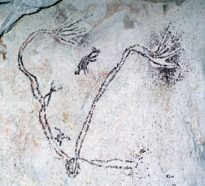
New analyses of ancient paintings in the caves of Borneo suggest that people made matchstick figures and images of hands at least 10,000 years ago. This means that people probably lived on the Asian island as many as 5,000 years earlier than archaeologists had previously thought.
 |
|
The cave artist twice applied pigment around a hand, then painted the lines joining the two hand shapes.
|
| Luc-Henri Fage |
It can be difficult to determine how old rock art is. One common way is to look at the amount of carbon in paint pigments. Carbon compounds break down at a predictable rate over time, giving scientists a clue about how long the paint has been there. Unfortunately, the paint used in the Gua Saleh Cave in southeast Borneo was made out of a type of iron compound, with no carbon.
Instead of looking at the pigment itself, the team of French archaeologists who analyzed the paintings looked at carbon in calcite deposits on top of the art. Calcite is the main ingredient of limestone and of cave formations such as stalagmites and stalactites.
Analyses showed that the calcite covering is about 9,900 years old. The researchers still don’t know how long the paintings had been there before that.
Ancient rock art can tell archaeologists a lot of interesting things about a culture, besides indicating how long people have lived in an area. The paintings at Gua Saleh might have been part of healing ceremonies or other rituals.
Some day, people might be analyzing the sketches you leave behind, too. So choose your messages carefully. Who knows what the archaeologists of the future will think of the times we live in?