Origami folds let paper support 9,000 times its weight, teen finds
Such ‘Miura-Ori’ folds could be used to design pop-up emergency shelters
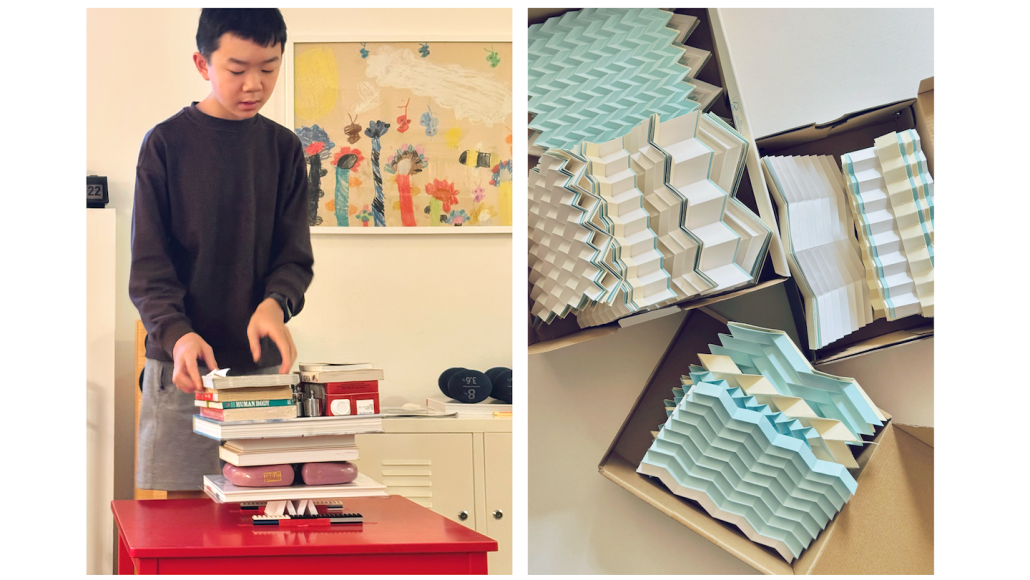
Miles Wu (left) tested how much weight different versions of the Miura-Ori origami folds (right) could support.
Society for Science
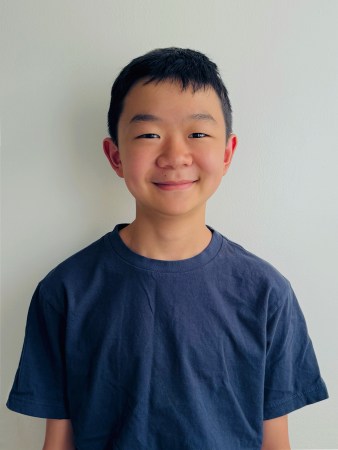
Miles Wu, 14, has been folding origami for seven years. Some of his favorite shapes to make are insects and birds. But recently, Miles got curious about a type of fold known as Miura-Ori. He’d read that this type of origami fold can be both compact and quite strong. That led him to wonder if he could use it in the design of pop-up emergency shelters.
To see which Miura-Ori fold would work best here, he tested how much weight each of 54 different types could support. They differed in the lengths and angles of their folds. He also used several types of paper. Miles placed heavier and heavier weights atop them until each collapsed.
The strongest Miura-Ori folds held more than 9,000 times their paper’s weight. Ones with smaller panels and sharper fold angles made using lightweight copy paper worked best.
An aspiring biologist, Miles did this project as an eighth grader at Hunter College High School in New York City. His research earned him the $25,000 top prize in the 2025 Thermo Fisher Scientific Junior Innovators Challenge. This program is run by Society for Science, which also publishes Science News Explores.
Here, Miles shares his research experiences.
What was the most rewarding part of this project?
“Realizing that these origami patterns are actually really strong,” Miles says. The one that held the most weight only collapsed under about 200 pounds. “I was really pleasantly surprised, because I didn’t think they would hold that much,” Miles says. “Halfway through my project, I realized that I would need heavier weights, so I [bought] these two really gigantic 50-pound exercise weights.”
What was the most difficult part?
“The amount of time it took,” Miles says. The total time to design, fold and test each Miura-Ori pattern took around 250 hours, he estimates. “I did it a lot over school breaks,” he says. Most of the work was done in his living room. “Sometimes it felt kind of repetitive. That was the most challenging part — actually having the commitment to finish the entire project.”
What were your most important resources?
“Definitely the past [origami] research that people have done,” Miles says. That includes people like NASA physicist Robert Lang and computer scientist Erik Demaine. (Demaine works for the Massachusetts Institute of Technology in Cambridge.) “They’re really cool. They’re my role models,” he says. “Also my family. They were also patient, because they let me do this entire project and take over the living room for a whole month to carry out my project.”
Any advice for science fair newbies?
“Explore hobbies and topics that you love, even if you don’t think they’re related to science fair research,” Miles says. Research projects can help you find new interests, he adds. “I did a project studying pigeons (their genetics) which stemmed from my love of birds,” he says. “I didn’t know anything about genetics or biology before that, but now it’s like my favorite subject.”