A little shape-up helps these pimple patches get a grip
Their anchoring tech might one day lead to shot-free vaccines, too
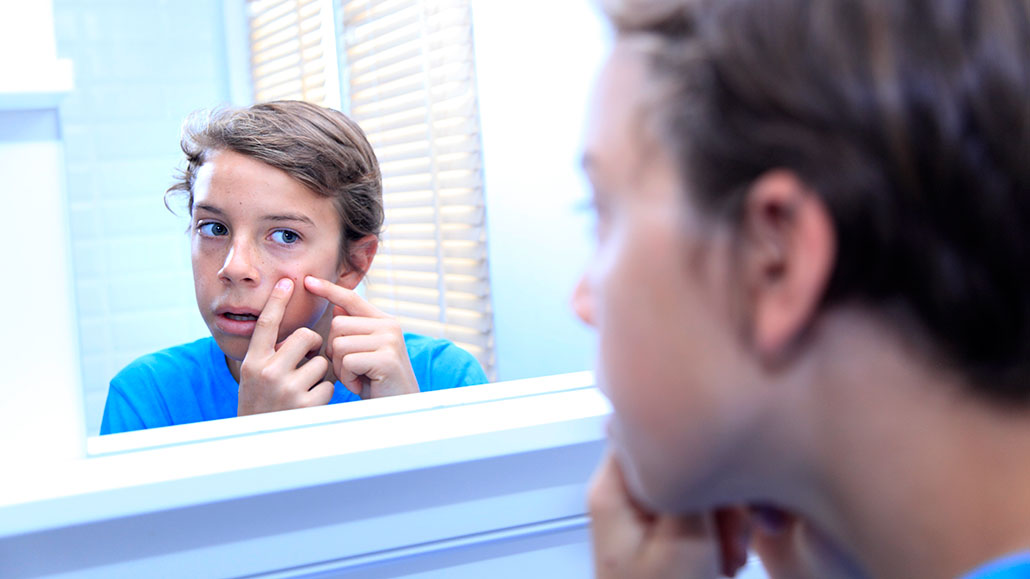
Acne and other skin blemishes can be especially common during adolescence. New microneedle technology helps some new antibacterial skin patches get a better grip.
Philippe TURPIN/Photononstop/Getty Images Plus
That pimple patch you’re using now is so last year. A new type locks on to pesky pimples better. Its secret is its tiny, uniquely shaped needles. They also help the patches more effectively deliver zit-fighting ingredients.
Even if you hate needles, the ones in the new patches shouldn’t spook you. They’re “very short,” notes Shayan Fakhraei Lahiji — about 250 micrometers. That’s about one-one hundredth of an inch long. A bioengineer, Lahiji works at Cursus Bio. It’s a drug company in Seoul, South Korea. He helped shape — literally — this new approach to acne treatment.

Each needle-packed patch is about the size of a contact lens and “almost invisible,” he says. Once placed on a pimple, its needles lock in. Over two hours, the tiny pricks dissolve and disappear. After that, you can remove the transparent patch, he says.
Hyaluronic (HY-uh-lu-RON-ik) acid — a chemical that plumps up our skin — gives structural support to the microneedles. Those tiny needles then deliver antibacterial compounds right where they’re needed. Inflammation-fighting chemicals also cool redness and swelling.
Among tests in treated people, more than eight in 10 of patched pimples disappeared within three days. Details of how the new tech works appear in the July Biological and Medical Applications of Materials and Interfaces.
Locking in
Lahiji’s team didn’t invent pimple patches. People can buy simpler styles today. Many of those, too, use microneedles. But needles in the new patches have a unique geometry that anchors them in place. It sets them apart from what you can buy now, Lahiji says.
The microneedles used in other drug-delivery patches tend to be cone-shaped. But that means they easily slip out of the skin. The Korean team gave their needles a bulb-shaped bottom. They call the design “MicroLock.” Like soft-edged-cylindrical barbs, they lock in place.
Most microneedles are cone-shaped. But the bulb-shaped base of needles on the new patches helps secure them onto the skin.

The value of this shape-up could expand beyond the acne market, Lahiji says.
Slipping out of skin is a known problem with microneedle technology, says Ayhan Çelik. A chemical biologist, he works at Imperial Bioscience Limited. That’s a drug technology company in Brighton, England. Çelik didn’t work on the new study. But he, too, has been working on microneedle patches using hyaluronic acid.
Such patches show a lot of potential, Çelik says. For instance, they might one day provide shot-free options for the delivery of some injectable drugs. Or even vaccines.
Such patches could offer other advantages, too, he adds. A shot puts a lot of the medicine into a tiny area. In contrast, Çelik notes, patches would deliver a drug to a broader area — “not a single point.” He believes that will lead to a better immune response than a typical shot.
The needles of the new acne patch are too short to deliver a vaccine. But Lahiji and his team have developed other versions that might enable other uses for the “locking” microneedles.
For now, notes Lahiji, “there are no microneedle products [for] medicines that require prescriptions.” Or for vaccines. But his team is working on ways that microneedles could deliver such drugs. One type would deliver medicines targeted at diabetes and obesity. His group described it in 2024 in Advanced Materials.
Getting government approval
Governments regulate what new medical products can be used in their countries. These rules ensure those products are safe. In the United States, for instance, the Food and Drug Administration, or FDA, writes those rules. Right now, no such rules exist for microneedle patches, Çelik notes. That makes them a headache for companies to develop and bring to pharmacies. “Everyone is waiting for” those guidelines, he says.
Acne patches are an exception to that. These patches are deemed “cosmetic,” not medical. Their needles not only are extra tiny, but they also deliver no prescription drugs — just over-the-counter acne-clearing meds.
Locking microneedles might help open the door for patch delivery of other medications. Why? When it comes to prescription drugs, how much a patch dispenses really matters, explains Çelik. The FDA would require a patch to deliver a set dose — not more, not less. Patches typically lack such consistency.
For example, a patch may deliver 40 percent of the drug one time. The next, it might deliver only 8 percent, notes Çelik. A microneedle patch for prescription medicines, he says, must deliver the same amount of drug “each and every time.”
By anchoring the new patches in place, the new microneedles should mean that “every time, they will deliver approximately 80 percent of the drug,” Çelik says. At least, he adds, “That’s what [its makers now] claim.”
Other problems remain to be solved, such as how big a dose they can dispense. For some drugs, the tiny needles may not be able to deliver enough to have the needed effect, says Çelik. In these cases, they may never fully replace hypodermic needles.
The new acne patch system was developed by Cursus Bio. Its product should hit store shelves in Korea by November, Lahiji says. U.S. consumers will have to wait a few months longer — until at least next January.
Do you have a science question? We can help!
Submit your question here, and we might answer it an upcoming issue of Science News Explores