All Stories
- Physics
Scientists Say: Yottawatt
On Earth, scientists measure energy use in watts. When you have lot of those watts — one million billion billion — you have a yottawatt.
- Health & Medicine
Newly discovered microbe keeps teeth healthy
A newfound bacterium halts the tooth erosion that leads to cavities. This germ or one like it might one day be added to toothpaste or mouthwash.
- Chemistry
Particles in air help fatten clouds’ water droplets
Making their own clouds has shown scientists how the fattest water droplets form. Understanding this could lead to better forecasts of climate change.
- Health & Medicine
Focusing on one sport ups a teen’s risk of injury
Want to decrease athletic injuries? Part of the answer may be to engage in more, and more varied, sports.
- Computing
Feeling objects that aren’t there
A new technology uses high-frequency sound waves to create virtual objects you can feel. Its uses include better video games and safer driving.
- Earth
Quake risk in some central states rivals California’s
Risks of tremors in some central U.S. states are as high as those in quake-prone California. The reason: waste fluids from oil and gas drilling.
- Chemistry
Gotcha! New test stalks diseases early
Chemists screen blood for disease markers by adapting a common DNA test. The test can find disease earlier, when it also may be easier to treat.
-
Sewing circuits: A crafty way to get kids interested in STEM
Many classrooms teach electric circuits with batteries and wires. But with e-textiles, students can help design and light up their own art projects.
- Health & Medicine
Why Paralympic sprinters have trouble with curves
Whether an artificial leg is on the right or left side of the body may affect how fast runners can take a turn.
- Physics
Scientists Say: Wavelength
When something travels as a wave — such as light — scientists can measure it by its wavelength, the distances between the peaks.
- Fossils
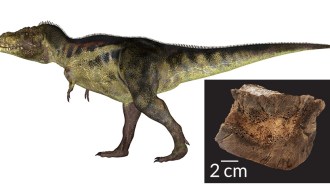
How to tell if a T. rex is expecting
A chemical test of tyrannosaur bone can determine whether the dino was pregnant — and therefore a female.
- Genetics
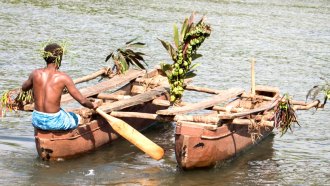
Pacific islanders got a double dose of Stone Age DNA
Unlike other people, certain Pacific Islanders inherited DNA from two ancient human ‘cousins.’