Why do objects shatter the same way? Math solves the mystery
Theory explains why most collisions show the same trend in piece sizes
Strange similarities show up in smashups of all kinds — from broken dinner plates (here) to asteroid collisions. Math at last explains why.
slowmotiongli/Creatas Video+/Getty Images Plus
This is a human-written story voiced by AI. Got feedback? Take our survey . (See our AI policy here .)
When an object shatters, something strange happens. It doesn’t matter whether the object is a dropped glass or plate. Or the nucleus of one atom smashing into another. Or even two asteroids colliding. When something splinters, the size of its fragments will follow the same trend. Math at last is able to explain why.
Scientists have been fascinated with fragmentation for a century. “It’s a kind of magic,” says Ferenc Kun. A physicist at the University of Debrecen in Hungary, Kun is an expert in fragmentation.
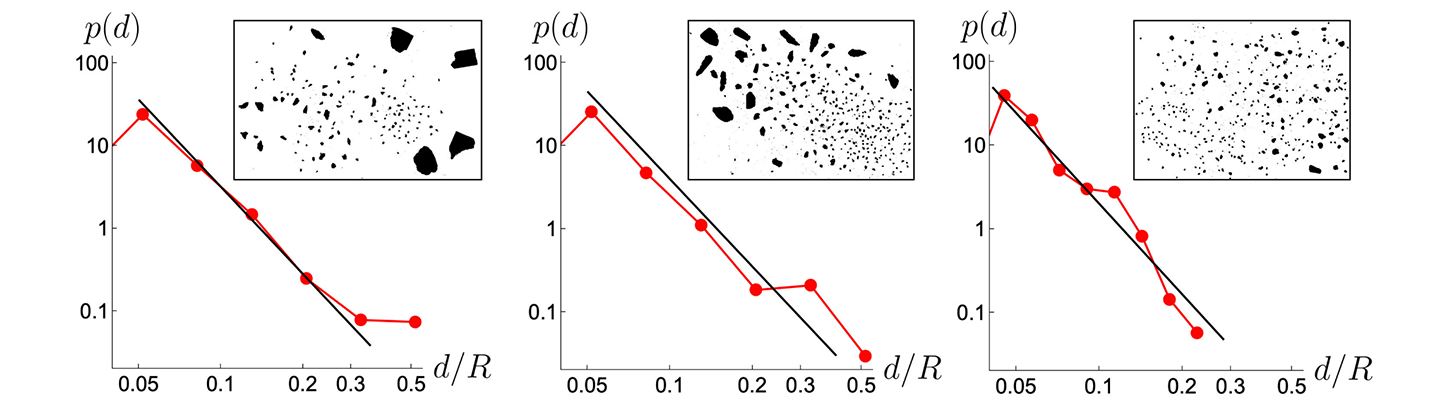
When you plot the number of fragments against their sizes, using logarithmic axes, you always get a straight, downward-sloping line. In other words, there are many more small pieces of debris than big ones. In math, this line is called a “power law.” Here, power refers to the slope of the line — or how tilted it is.
The same straight line somehow emerges when graphing the smithereens of widely different things. If you froze a potato in liquid nitrogen and dropped it, Kun says, you’d get the same spread of remnant sizes as if you exploded coal in a coal mine.
A longstanding question has been: why?
Emmanuel Villermaux has now come up with an explanation. His theory doesn’t just show why a graph of the fragment sizes is a straight line. It also predicts what the slope of that line should be for different objects. Villermaux is a physicist at Aix Marseille University in France and Institut Universitaire de France. He shared his new findings last November in Physical Review Letters.
This theory does more than just solve a longstanding mystery, notes physicist Nicolas Vandenberghe. He, too, works at Aix Marseille University, but did not take part in the new research.
Many industrial processes “need to have the right size of a fragment,” notes Vandenberghe. He points to coal. It doesn’t burn well if the chunks are the wrong size. Another example is sandpaper. Its grit, made of shattered mineral pieces, needs to have a very specific and uniform size. So Villermaux’s new theory could have plenty of uses in industry.
A simple theory
Before something breaks apart, cracks appear and spread through it. In the past, scientists often studied how those cracks develop as a way to understand fragmentation. But those theories had always depended on some particular collision. Researchers needed to use details of that specific collision to explain the effects.
Villermaux took a step back. He considered what would have to be true for all breakups.
And his work, Kun says, “shows that actually, the mechanism [of shattering] is not important” to the outcome.
Villermaux took two broad ideas. First was the concept of “maximal randomness.” It comes from thermodynamics. That’s a branch of physics that looks at how materials can have different forms of energy and how energy moves between these forms.
Maximal randomness predicts that the most likely outcome of any process is the one with the most ways it could occur.
Take the rolling of two dice. There are six ways you can throw the dice so that their numbers add up to seven: 1 and 6, 2 and 5, 3 and 4, 4 and 3, 5 and 2, and 6 and 1. But there is only one way you can roll dice that add up to two: 1 and 1. It’s more likely, therefore, that you’ll roll a seven.
Scientists now use this thinking for the outcome of fragmentation. The spread of sizes when something shatters is likely to be the spread that has the most ways of occurring.
Second, Villermaux knew that mass must be conserved. The mass of all fragments must equal the starting mass of the unbroken object. But he devised a simpler version. He showed that a form of density — mass per volume — must be approximately conserved, too, when something shatters.
Villermaux then figured out, using math, what size distribution of rubble you’d get if both ideas were true. The answer turned out to be a power law!
Dimensions and details
Villermaux’s formula also predicts the power law’s slope when graphing fragment sizes for different objects. His slope didn’t depend on how an object shattered, or its size, or its shape or what it was made of. It depended only on the object’s so-called dimension.
Take objects that are shaped like a line — a pencil or a chopstick. A plot (or graph) of the fragment sizes for such roughly “one-dimensional” or “1-D” objects would have a slope of -1. In other words, as the size of the fragment increases, the number of fragments of that size decreases at about the same rate.
Some things, such as dinner plates, have notable length and width but little height. The slope of these more or less two-dimensional (2-D) objects would be about -2.2. So as the size of the fragments increases, the number of fragments drops off a bit faster than for 1-D objects.
And for truly 3-D objects — like bowling balls, with notable length, width and height — the slope would be -3.5.
These slope values agree across a wide array of experiments by Villermaux and other scientists. For example, crushing uncooked spaghetti (which is roughly 1-D) creates debris whose size plot has a slope of -1.3. Thin packaging materials torn apart in the ocean (roughly 2-D) show a slope of -2.4. And 3-D air bubbles under breaking waves give a slope of -3.5.
There are, however, exceptions
Some things do break these general rules. To account for them, Villermaux extended his theory in several ways.
For instance, the distribution of the largest fragments often falls below the predicted straight line. So Villermaux derived a more complex version of his formula. It accounts for the conservation of energy in addition to conservation of mass. Then he re-graphed some 90-year-old data on logarithmic axes. His more complex prediction of fragment sizes could now more fully explain that old experiment.
“It is very nice” to look at nearly century-old data with new thinking, he says. “When you look at them more carefully, you discover something new.”
Villermaux could even explain the fragmentation pattern of soft objects. They break apart differently than brittle ones. A Frisbee, for instance, doesn’t shatter the same way as a ceramic dinner plate. That’s because tiny cracks in plastic can “heal” or essentially close up. Villermaux thus assumed that some portion of smaller plastic fragments would not form.
He thus calculated an “effective” slope for plastics. It’s a flatter distribution, with fewer small fragments and more large ones. His extended theory predicts an effective slope for 3-D plastic objects of 1.5.
Villermaux’s work agrees well with the results of a 2010 study by Kun and others. In that experiment, they’d looked at the debris shed by plastic balls thrown against a wall and calculated an effective slope of 1.6.
Kun is thrilled that Villermaux’s theory can explain what they saw. “In this very general mathematics, he can incorporate the effect of plasticity,” Kun says. “This is amazing!”
Do you have a science question? We can help!
Submit your question here, and we might answer it an upcoming issue of Science News Explores