Energy may seem to disappear, but there’s a law against that
Always conserved, energy just morphs from one form to another
Bounce, bounce, stop: Each ball’s energy converts from potential to kinetic to heat — proving that energy never vanishes, just transforms.
Iserg/Creatas Video+/Getty Images Plus
This is a human-written story voiced by AI. Got feedback? Take our survey . (See our AI policy here .)
A bouncing ball eventually will roll to a stop. After a long day of scrolling, a phone battery will die. Eventually, every campfire will burn out. In each case, it seems like some energy disappeared. Except it can’t — not even a little bit. A law of physics prohibits that.
“Energy can never disappear nor appear,” explains Krista Freeman. She is a physicist who works at Case Western Reserve University in Cleveland, Ohio. There, she uses physics to study living things, such as viruses.
“You can’t make it and you can’t destroy it,” she says of energy. It “can only ever be converted from one form to another.” That’s known as the law of energy conservation.
A cornerstone of science, it applies to everything, from exploding stars to each cell in your body.
Here, we explain why it can’t disappear when your phone dies or those campfire embers finally turn cold.
What is energy?
The Merriam-Webster dictionary defines energy as anything from “vigorous exertion” to “the capacity of acting or being active.” That’s rather arm-wavy. But in physics, the term energy means something quite specific and measurable. It simply means the ability to do work.
Energy is what allows a car to move, a light bulb to glow or your muscles to lift your backpack. Without energy, nothing in the universe could change or move.
Energy can exist as light, heat, sound, movement — even the position of an object. Think of it like money. You might have cash in your wallet, a gift card or a nice balance in some bank account. It’s all money — just in different forms.
Energy works the same way.
A moving skateboard has kinetic energy — the energy of motion. A book sitting on a shelf has potential energy because of its height. (It has the potential to fall off the shelf, turning the energy stored in its height into kinetic energy.) Even sitting on the ground, a book’s pages have energy; they can fuel a fire. Our sun radiates energy in the form of heat and light. Sound from your phone’s speaker moves in waves of energy.
Just as you can save money in a bank for later, energy can be stored, too. Batteries store chemical energy, as does food. Your body stores energy in fat cells for later use.
So energy is all around you — in motion, in heat, in sound, in light, stored in food and fuel. But here’s the puzzle: When a rolling ball stops or a battery “dies,” where does all that energy go?
Following the bouncing ball
Energy doesn’t go anywhere. It just transforms.
Take that ball. “When we see a ball stop bouncing, it is easy to think that the energy it has has disappeared,” Freeman says. But that’s a mistake, she adds. “Energy can never disappear nor appear.”
What actually happens is that the energy converts from potential to kinetic to frictional energy, or heat. Let’s break it down.

A ball falls from a height. While the ball is up high, it has potential energy due to its position. But as gravity pulls it down, that potential energy converts into the energy of motion.
When the ball slams onto the pavement, its kinetic energy splits up. Some turns into the sound energy you hear as a sharp thwack. Some gets absorbed by the ground as heat. But the ball doesn’t immediately come to a stop. Some of its kinetic energy remains, bouncing it back upward. It rises, but not as high as before — because it no longer has the energy that was transformed into sound and heat. With less energy, the bounce cannot push the ball as far upward.
The ball falls and bounces again. Each time it hits the ground, more of its energy converts into sound and heat. Eventually, all of its initial potential energy will have morphed into heat and sound. This allows the ball to roll to a stop.
In each step, energy is transformed from one type to another — spreading through the ground as heat and the air as sound waves.
A universal law
That physical law on the conservation of energy holds that energy can change forms. It just can never be created or destroyed.
“Conservation of energy is so important to science because it is the one thing that is always true in the world as we experience it,” Freeman says. “It applies equally to an elephant and to an ant.”
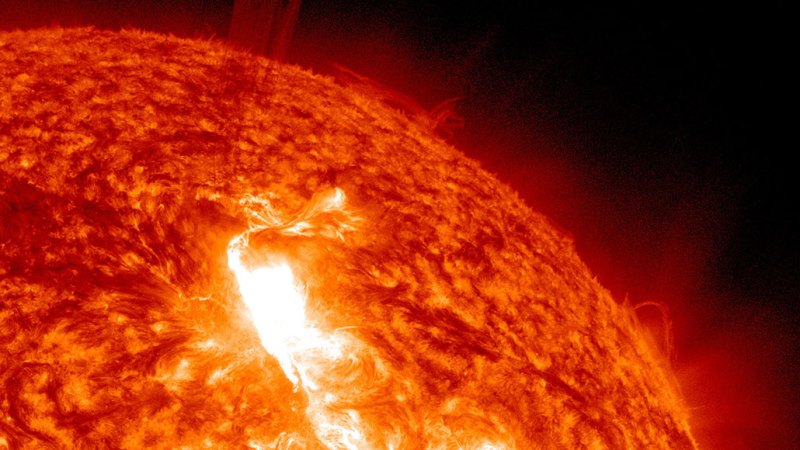
And it shows up everywhere. Consider fusion reactions, which power the sun and other stars. Here, two atoms combine to form a larger atom, releasing energy in the process.
“In the case of fusion, you’re actually getting energy from nuclear bonds, which are [very strong],” explains Uri Shumlak. He co-founded Zap Energy in Everett, Wash. This company is developing fusion as a potential energy source.
Nuclear bonds are the forces that hold atoms together. These bonds store enormous amounts of energy. When hydrogen atoms fuse into helium, for instance, some of the hydrogen atoms’ energy will radiate out as light and heat.
If you lit a regular wooden matchstick and a matchstick-sized piece of fusion fuel, Shumlak says, the fusion fuel would release about 10 million times more energy than the matchstick.
Fusion can sustain a star’s steady emission of light and heat for billions of years. This is why fusion energy interests scientists so much. If it could be controlled on Earth, small amounts of fuel could power entire cities.
What using energy means
A lot of the confusion surrounding energy comes from how we all use it in everyday language. We’ve all learned to use the term in a very non-scientific way. To say batteries “die” or that power plants “generate” energy is a misnomer. These phrases don’t accurately describe what’s happening.
A “dead” battery no longer works because its stored chemical energy has been converted to heat and electricity. That electricity powered your phone. Similarly, when we say power plants “generate” energy, it’s not being created out of nowhere. Instead, power plants convert energy from a solid — usually a fossil fuel (such as coal) or uranium (a radioactive element) — into heat and light. That heat then drives a turbine, which transforms mechanical energy into a flow of electrons: electricity.
This leads to another misunderstood term: renewable energy.
Do you have a science question? We can help!
Submit your question here, and we might answer it an upcoming issue of Science News Explores
“Renewable energy isn’t really a scientific term,” Shumlak explains. “As far as the universe is concerned, all energy is conserved.” In a sense, then, it’s all renewable.
We use the term renewable energy to refer to energy sources that effectively won’t run out (at least in humanity’s lifetime). That makes solar, wind, geothermal and hydropower essentially unlimited resources.
“Words like renewable, sustainable, green or clean, they all mean slightly different things,” Shumlak says. Still, they “get at the idea that humans will exist longer and have better lives if we can find ways to [use energy sources] that have less detrimental effects on the planet.”