This is the largest, most detailed radio image yet of our Milky Way
It unveils greater details of what’s happening within our galaxy
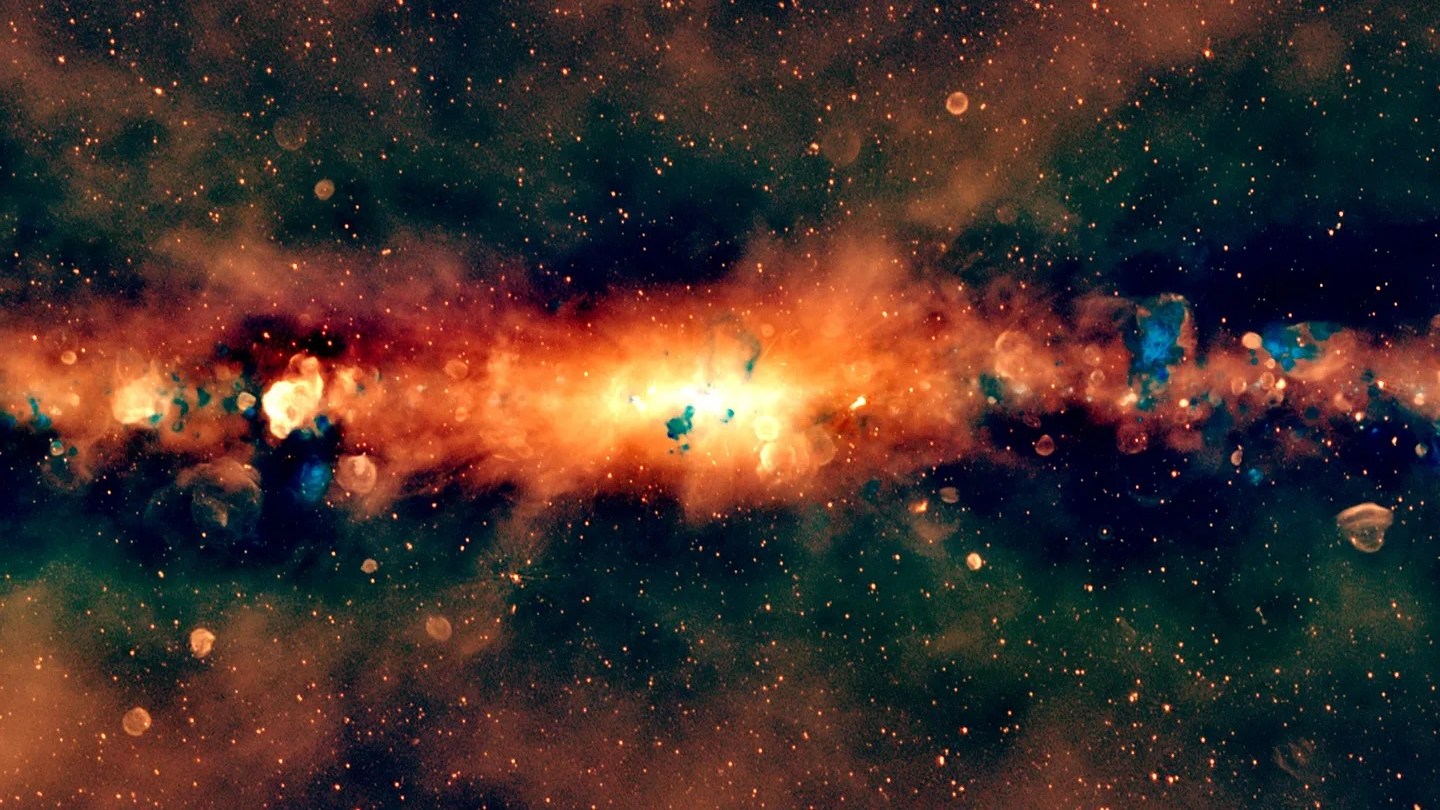
Astronomers created this view of the Milky Way by looking at radio wavelengths. It’s the largest, most detailed image assembled of our galaxy in radio light, as viewed from Earth. In the galactic center (shown), red and blue bubbles represent objects emitting radio light, such as supernova remnants and stellar nurseries.
S. Mantovanini and the GLEAM-X team
A ribbon of red splotches peppered with blue dots offers a new view of our Milky Way. It’s the largest, most detailed image of our galaxy in radio wavelengths ever assembled. Researchers describe what it shows October 28 in Publications of the Astronomical Society of Australia.
Taken from Earth’s southern hemisphere, the image is a new side view of our fairly flat spiral galaxy. It will help astronomers find and classify objects within the Milky Way.
The new image was prompted by a search for supernova remnants. These are leftover bubbles of gas and dust from exploding stars. These remnants can emit radio waves for tens of thousands of years, says Silvia Mantovanini. She’s an astronomer at Curtin University in Perth, Australia. So most of these objects have been found when looking for radio light.
Researchers have found about 300 supernova remnants in the Milky Way. Scientists estimate some 2,000 likely exist. However, it’s been difficult in past studies to tell these remnants apart from other objects. Studying more stellar remains will shed light on the last stages of stars’ life cycles and their explosive ends, says Mantovanini.
For the new image, researchers compiled radio wavelengths captured over more than 140 nights. These data were collected by the Murchison Widefield Array telescope in Western Australia. The telescope mapped the southern hemisphere’s sky as part of two surveys between 2013 and 2020.
Each observation took a snapshot of one section of the sky. Each lasted about two minutes and captured a specific range of radio wavelengths. Supercomputers then stitched together almost 2,000 of these observations.

This revealed a dazzling edge-on view toward the center of the Milky Way. It spans roughly 60,000 light-years. That’s just over half the galaxy’s width.
The team then stacked 20 versions of the image. They gave each a different color. Those colors denote various ranges of radio wavelengths. Longer ones appear red. Shorter wavelengths are shown as blue.
Those colors hint at what’s behind the radio emissions. Heat-related radiation from stellar nurseries, for instance, look like blue bubbles. Emissions from supernova remnants that don’t come from heat appear as red bubbles.
This colorful view of the Milky Way makes it easy to see what’s going on within our galaxy, Mantovanini says. Its creation “reminded me that we’re just a small part of something incredibly complex.”