chemical: A substance formed from two or more atoms that unite (bond) in a fixed proportion and structure. For example, water is a chemical made when two hydrogen atoms bond to one oxygen atom. Its chemical formula is H2O. Chemical also can be an adjective to describe properties of materials that are the result of various reactions between different compounds.
crystal: (adj. crystalline) A solid consisting of a symmetrical, ordered, three-dimensional arrangement of atoms or molecules. It’s the organized structure taken by most minerals. Apatite, for example, forms six-sided crystals. The crystalline components of a rock are usually too small to be seen with the unaided eye.
electron: A negatively charged particle, usually found orbiting the outer regions of an atom; also, the carrier of electricity within solids.
fluorescent: (v. fluoresce) Adjective for something that is capable of absorbing and reemitting light. That reemitted light is known as fluorescence.
Greenland: The world’s largest island, Greenland sits between the Arctic Ocean and North Atlantic. Although it is technically part of North America (sitting just east of Northern Canada), Greenland has been linked more politically to Europe. Indeed, Vikings arrived in Greenland around the 10th century, and for a time the island was a colony of Denmark. In June 2009, Greenland became an independent nation. Ice covers roughly 80 percent of Greenland. Indeed, the Greenland ice sheet is the world’s largest. If its frozen water were to melt, it could raise sea levels around the world by 6 meters (about 20 feet). Although this is the 12th biggest nation (based on surface area), Greenland averages the fewest people per square kilometer of its surface area.
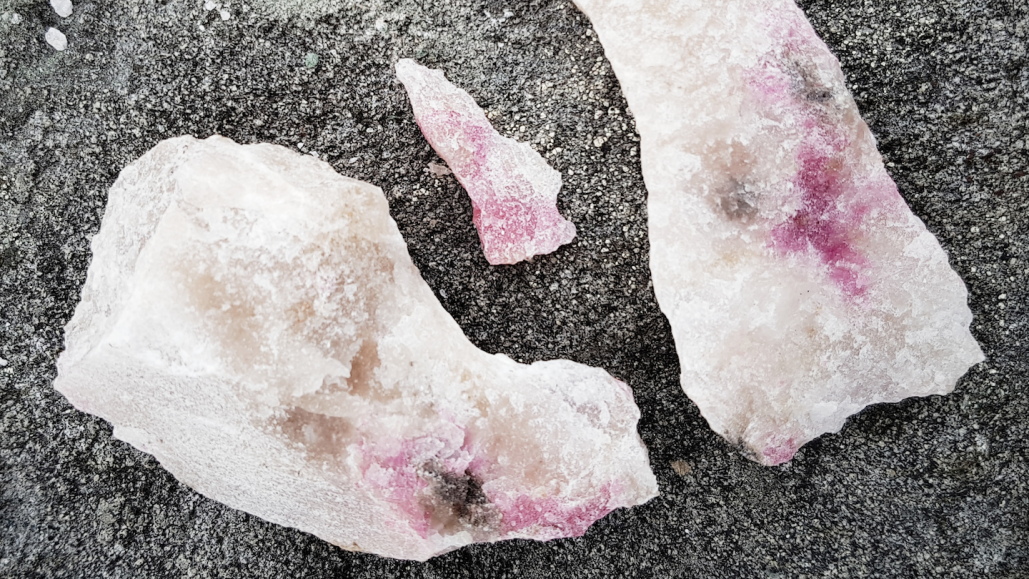
mineral: Crystal-forming substances that make up rock, such as quartz, apatite or various carbonates. Most rocks contain several different minerals mish-mashed together. A mineral usually is solid and stable at room temperatures and has a specific formula, or recipe (with atoms occurring in certain proportions) and a specific crystalline structure (meaning that its atoms are organized in regular three-dimensional patterns).
particle: A minute amount of something.
sulfur: A chemical element with an atomic number of sixteen. Sulfur, one of the most common elements in the universe, is an essential element for life. Because sulfur and its compounds can store a lot of energy, it is present in fertilizers and many industrial chemicals.
ultraviolet: A portion of the light spectrum that is close to violet but invisible to the human eye.
unique: Something that is unlike anything else; the only one of its kind.
zircon: A gemstone that contains traces of the radioactive element uranium. It develops as a crystal that forms as magma (from deep inside Earth) begins to cool. Some of the oldest minerals surviving on the planet are crystals of zircon that are at least 4.2 billion years old. For perspective, Earth is only 4.56 billion years old.