biologist: A scientist involved in the study of living things.
cell: (in biology) The smallest structural and functional unit of an organism. Typically too small to see with the unaided eye, it consists of a watery fluid surrounded by a membrane or wall. Depending on their size, animals are made of anywhere from thousands to trillions of cells. Most organisms, such as yeasts, molds, bacteria and some algae, are composed of only one cell.
colleague: Someone who works with another; a co-worker or team member.
degrade: To break down into smaller, simpler materials — as when wood rots or as a flag that’s left outdoors in the weather will fray, fade and fall apart. (in chemistry) To break down a compound into smaller components.
DNA: (short for deoxyribonucleic acid) A long, double-stranded and spiral-shaped molecule inside most living cells that carries genetic instructions. It is built on a backbone of phosphorus, oxygen, and carbon atoms. In all living things, from plants and animals to microbes, these instructions tell cells which molecules to make.
focus: (in physics) The point at which rays (of light or heat for example) converge sometimes with the aid of a lens. (In vision, verb, "to focus") The action a person's eyes take to adapt to light and distance, enabling them to see objects clearly. (in behavior) To look or concentrate intently on some particular point or thing.
gene: (adj. genetic) A segment of DNA that codes, or holds instructions, for a cell’s production of a protein. Offspring inherit genes from their parents. Genes influence how an organism looks and behaves.
genetic: Having to do with chromosomes, DNA and the genes contained within DNA. The field of science dealing with these biological instructions is known as genetics. People who work in this field are geneticists.
ice age: Earth has experienced at least five major ice ages, which are prolonged periods of unusually cold weather experienced by much of the planet. During that time, which can last hundreds to thousands of years, glaciers and ice sheets expand in size and depth. The most recent ice age peaked 21,500 years ago, but continued until about 13,000 years ago.
microRNA: Short pieces of RNA that do not code for the production of proteins. Instead, they influence whether and how proteins are produced by interfering with normal production processes.
molecule: A group of atoms that represents the smallest possible amount of a chemical compound. Molecules can be made of single types of atoms or of different types. For example, the oxygen in air is made of two bound oxygen atoms (O2). Water is made of two hydrogen atoms and one oxygen atom (H2O).
muscle: A type of tissue used to produce movement by contracting its cells, known as muscle fibers. Muscle is rich in protein, which is why predatory species seek prey containing lots of this tissue.
permafrost: Soil that remains frozen for at least two consecutive years. Such conditions typically occur in polar climates, where average annual temperatures remain close to or below freezing.
RNA: A molecule that helps “read” the genetic information contained in DNA. A cell’s molecular machinery reads DNA to create RNA, and then reads RNA to create proteins.
species: A group of similar organisms capable of producing offspring that can survive and reproduce.
stress: (in biology) A factor — such as unusual temperatures, movements, moisture or pollution — that affects the health of a species or ecosystem.
tissue: Made of cells, it is any of the distinct types of materials that make up animals, plants or fungi. Cells within a tissue work as a unit to perform a particular function in living organisms. Different organs of the human body, for instance, often are made from many different types of tissues.
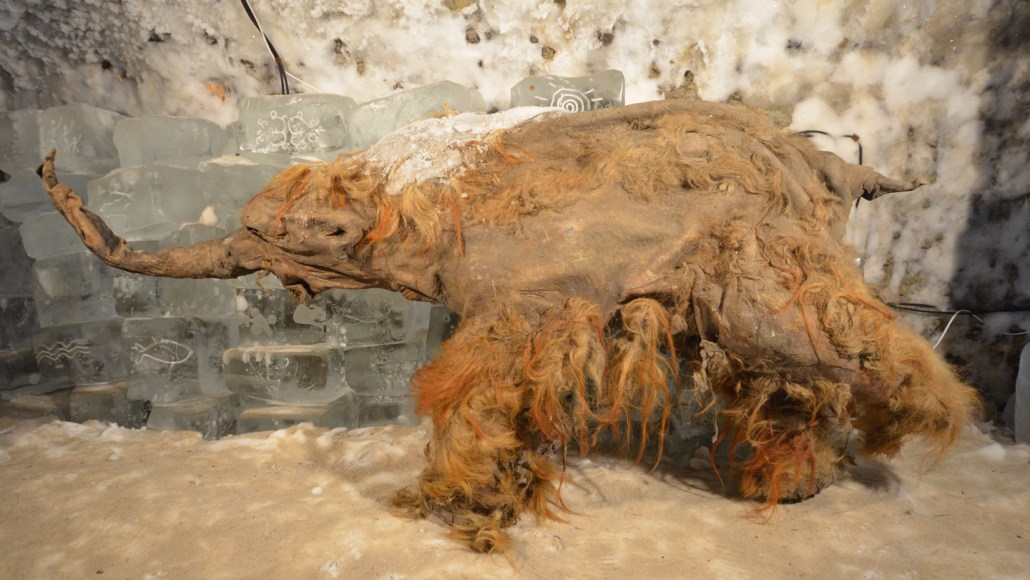
woolly mammoth: A type of extinct mammal that resembled a hairy elephant.