Surprise! Wax seems key in turning honeybee larvae into queens
A special wax in the ‘crib’ seems to help larvae develop into royals
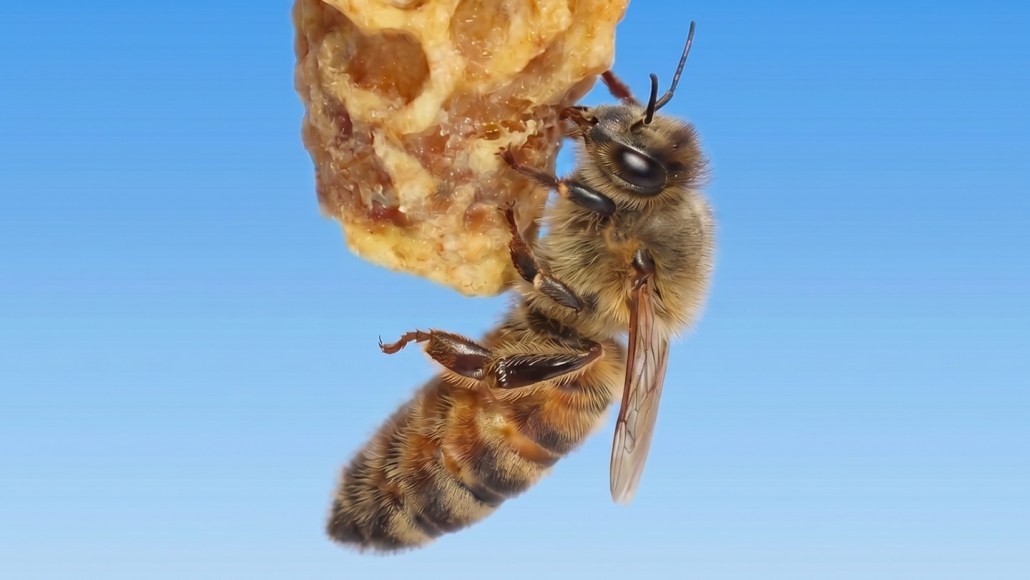
A queen honeybee clings to the peanut-shaped wax of her cell. New research finds that this wax helps shape whether a bee becomes a commoner or a queen.
Yu Fang/Chinese Academy of Agricultural Sciences
Share this:
- Share via email (Opens in new window) Email
- Share on Facebook (Opens in new window) Facebook
- Share on X (Opens in new window) X
- Share on Pinterest (Opens in new window) Pinterest
- Share on Reddit (Opens in new window) Reddit
- Share to Google Classroom (Opens in new window) Google Classroom
- Print (Opens in new window) Print
Kids learn in grade school that honeybees “create” a new queen bee by feeding a larva royal jelly. A new study find that the young bee’s diet may be only part of what crowns her queen. The chemical makeup of a small “room” in the hive where she grows up also appears to play a key role.
Most honeybee larvae develop in identical six-sided chambers, or cells, inside the hive. But these common quarters aren’t quite fit for a queen. Actually, they aren’t big enough. So when a hive needs a new queen, worker bees develop some larger peanut-shaped cells. The workers then put a fertilized egg in each of these special rooms and feed it a nutritious substance commonly called royal jelly.
Boris Baer is an entomologist, or insect biologist, at the University of California, Riverside. As a home beekeeper, he’s spent years observing his own hives. Many people learn as kids that feeding a young bee royal jelly is what turns a commoner into the queen. But Baer was also curious about the queen’s growth chamber. “Could [this] cell itself contribute to queen development?” he asks.
The new study suggests it does. Physical and chemical properties of this chamber’s walls appear to tip a larva toward the throne.
An international research team, including Baer, shared this finding in the June 18 Nature.
“The discovery is very cool and thought-provoking,” says Thomas Seeley. He’s a biologist at Cornell University in Ithaca, N.Y., who did not take part in the new work. “To me, queen cells [growth chambers] have long seemed important,” he says. Odors from a growing queen may permeate its walls, he says. This might mark these cells as “very special spots that workers recognize and don’t accidentally damage.”
The ‘royals’ and their attendants
Honeybees come in three types: workers, drones and queens.
Most eggs laid in hexagonal cells develop as worker bees. All are female. Workers build and maintain the hive. They collect pollen and nectar and convert nectar to honey. They also care for larvae. Larvae in the remaining hexagonal cells develop as males, known as drones. These leave the hive and reproduce with queen bees elsewhere.
A small handful of a hive’s cells are built differently. They house future queens. Baer and his team refer to these as “royal cribs.” A subset of nurses, known as “royal nurses,” exclusively care for these future queens.
Bees spend a lot of time and energy building queen cells. “This makes little evolutionary sense,” Baer says, “if they were merely larger food containers.” And his team’s new data suggest they aren’t.
All larvae — royals and regulars — spend a few days eating and growing before worker bees seal their cell with a wax cap. Afterward, each larva will morph into a pupa. That’s the next stage in a bee’s metamorphosis toward adulthood.
The role of wax
Baer’s team studied two species: western honeybees (Apis mellifera) and eastern honeybees (A. cerana). First, the researchers analyzed the wax in royal cribs and worker cells. Queen-cell wax, they found, is softer and less dense than worker-cell wax. It’s also chemically different.
Royal nurses spend more time building queen cells than worker bees spend building worker cells. This surprised Baer. Bodies of royal nurses were also warmer. This slightly warms a future queen’s surroundings. It also might help soften or melt the wax, making it easier to work with, the researchers say. They didn’t test this, however.
Royal nurses also show unusual patterns of gene activity. This suggests they are specially adapted to modify the wax they make, Baer says.
Do you have a science question? We can help!
Submit your question here, and we might answer it an upcoming issue of Science News Explores
The researchers then compared how a wax cap might affect a royal larva’s survival.
To test this, they conducted wax swaps. They removed newly hatched larvae from queen cells and placed them in tiny plastic queen cups. They returned the cups to the hive, where nurse bees fed these larvae royal jelly for the next four days. The researchers then replaced the bees’ old wax caps with new wax. Some came from a royal crib. Others got wax from a worker’s growth crib.
Nearly two out of every three queen larvae under the worker-cell wax died. That’s twice the death rate of larvae given new queen-cell wax. Queens reared under queen-cell wax more closely resembled those left undisturbed in their natural cells. The pupae of those left to morph under worker-cell wax turned out smaller.
Is this engineering?
“Everything was supporting the same conclusion,” Baer says. Bees do more than feed the queen: They “actively engineer them.”
Exactly how that engineering works remains unclear. Kai Wang is an apiologist, or bee scientist, in Beijing. He works at the Chinese Academy of Agricultural Sciences and is a co-author of the new study. He finds the scents inside the cells especially intriguing.
“Are [those scents] influencing the developing queen’s senses, preparing her for mating and life after emergence?” he asks. “Are some produced by the larva herself? And could the future queen be actively communicating with the workers constructing her chamber?”
The researchers hope to find out by answering: When and how does the wax affect a bee’s development? Their findings could affect more than a queen’s evolution, Baer says. “These superorganisms [beehives] mobilize specialized workers that collectively shape the next generation,” he says. “The division of labor in bees might be much more complex than we have acknowledged so far.”