Questions for ‘Antarctica faces a green and weedy future’
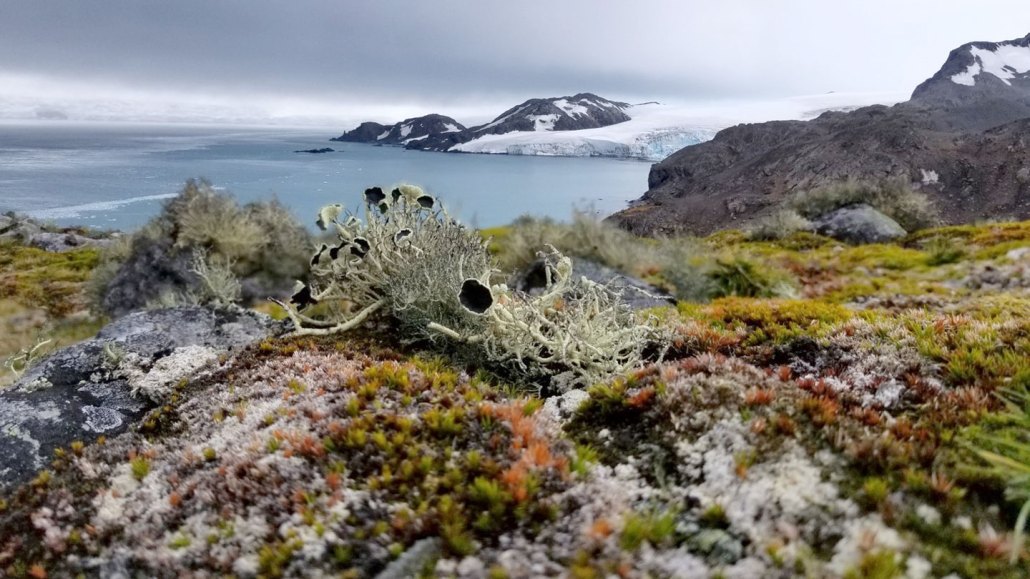
At rare places along the Antarctic Peninsula, the ground is covered by a carpet of moss and lichens that creeps over the rocks. The vast majority of Antarctica, however, remains covered by a deep blanket of glacial ice (seen in background).
Felix Grewe/Field Museum
Share this:
- Share via email (Opens in new window) Email
- Share on Facebook (Opens in new window) Facebook
- Share on X (Opens in new window) X
- Share on Pinterest (Opens in new window) Pinterest
- Share on Reddit (Opens in new window) Reddit
- Share to Google Classroom (Opens in new window) Google Classroom
- Print (Opens in new window) Print
To accompany ‘Antarctica faces a green and weedy future’
SCIENCE
Before Reading:
- What is an ecosystem? Describe the typical ecosystem that comes to mind when you think of Antarctica.
- How does an invasive species differ from a native one? How might an invasive species threaten native species? List at least two possible ways.
During Reading:
- Which continent is King George Island part of?
- How many degrees Celsius has the Earth warmed since 1850? Contrast the temperature changes of the Antarctica Peninsula with the global average.
- Briefly describe how the diversity of life has changed in Antarctica over the last 40 million years.
- How did the area covered by Antarctica’s native grass and pearlwort change between 1960 and 2018?
- According to a new study published in February, how much might the Antarctic Peninsula warm by 2100?
- How many non-native species currently live in Antarctica? Give specific examples of a non-native plant and animal species.
- How might current environmental changes benefit non-native species more than native ones?
- Research shows that Antarctic soils inhabited by an invasive midge differ chemically from non-inhabited soils. Describe this change in one sentence.
- Stef Bokhorst and his team learned that 18 of 26 tested non-native species were able to sprout and grow in “typical Antarctic soil” and under simulated seasonal conditions. Why did this finding concern Bokhorst?
- Why have researchers studied non-native species found in the “subantarctic” region? How do these studies relate to studying Antarctica’s ecosystems?
After Reading:
- Explain what is meant by soil “enrichment” in the context of this story. What are some consequences of this enrichment? Besides Antarctica, what is another environment or ecosystem that is affected by some sort of “enrichment” of the soil or water? Explain your answer.
- In a cause-and-effect relationship, one change — the “cause” — triggers a second change, which is the “effect.” Cause-and-effect pairings often link together into a chain of events. In other words, an effect becomes a cause for another change. Take note of the changes that take place on exposed ground after a glacier retreats. Pay particular attention to the role of different groups of living things — such as plants and microorganisms — in bringing about these changes. Identify three pairs of interlinked cause-and-effect changes starting with a glacier’s retreat. (Think of the glacier’s retreat as your first cause.)
- Use a simple diagram or schematic to illustrate the cause-and-effect linkages you identified in the last question. (For instance, consider writing each pairing into a “chain-link fence” pattern of overlapping interlinked circles.) Then, speculate on how the last effect in your schematic might bring about a new change. Describe this speculation in a short paragraph and ensure to explain how it connects to the last effect in your schematic.