Questions for ‘Like living mood rings, these bees change color when it turns humid’ 
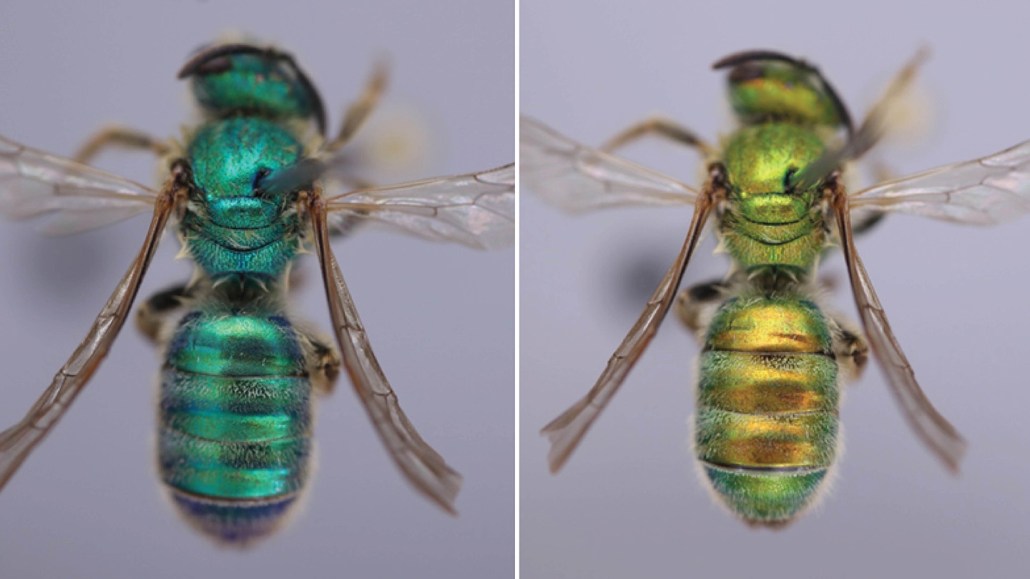
An iridescent bee is shown before and after being exposed to humidity. On the left, the bee is a dark blue-green, and on the right, the bee is a greenish gold

A museum specimen of the fine striped sweat bee changes color. It goes from blue-green in dry air (left) to green-copper in humid air (right). Most of the color change occurs in the first 24 hours.

Jorge De La Cruz

To accompany ‘Like living mood rings, these bees change color when it turns humid’

SCIENCE

Before Reading:

  1. Start with a blank sheet of paper. Sketch a simple, side view of two evenly shaped sets of waves: one across the top of a sheet of paper, the other across the bottom. Make the first set of waves short and choppy. Give the second set long waves. Ensure that for each set, the waves extend the full width of the paper.

    Next, consider the terms wavelength and frequency. Scientists use these words to describe characteristics of waves. Draw a star next to the set where the waves are longer, so having longer wavelengths. Then, draw a square next to the set whose waves exhibit a higher frequency. Think of frequency as the number of waves occurring per unit of time.

    Finally, describe the relationship between wavelength and frequency. For a given set of waves, as the wavelength increases, what happens to the frequency of the waves per unit of time?
  2. The electromagnetic spectrum depicts the wavelengths of light and organizes them into categories. For instance, light detectable to the human eye is called “visible light.” Within the range of visible light, how does the human eye interpret different wavelengths?

During Reading:

  1. Describe how an increase in humidity changes the appearance of the bees described in this story.
  2. Explain how a routine lab practice led to Jorge De La Cruz’s new observation of bee color.
  3. What is the common name for Agapostemon subtilior?
  4. Describe how scientists De La Cruz and Ostwald conducted their study on two dozen bee specimens held in museums.
  5. The term “citizen science” refers to research carried out by people who are not trained scientists. Give an example of how citizen science contributed to this study.
  6. What physical change in the bee’s exoskeleton do researchers believe causes the color-shift
  7. Our eyes perceive light of different wavelengths as being different colors. Using information from the article, explain why the bees appeared more reddish under certain conditions.

After Reading:

  1. What are the next steps for researchers in this study? Why do you think those next steps are important?
  2. Consider the discovery described in this story. What is one way that such discoveries might be applied to help people or to develop new technologies? Give an example of a potential application. Feel free to be creative.