Questions for ‘New clues about dino speed come from birds strutting through mud’ 
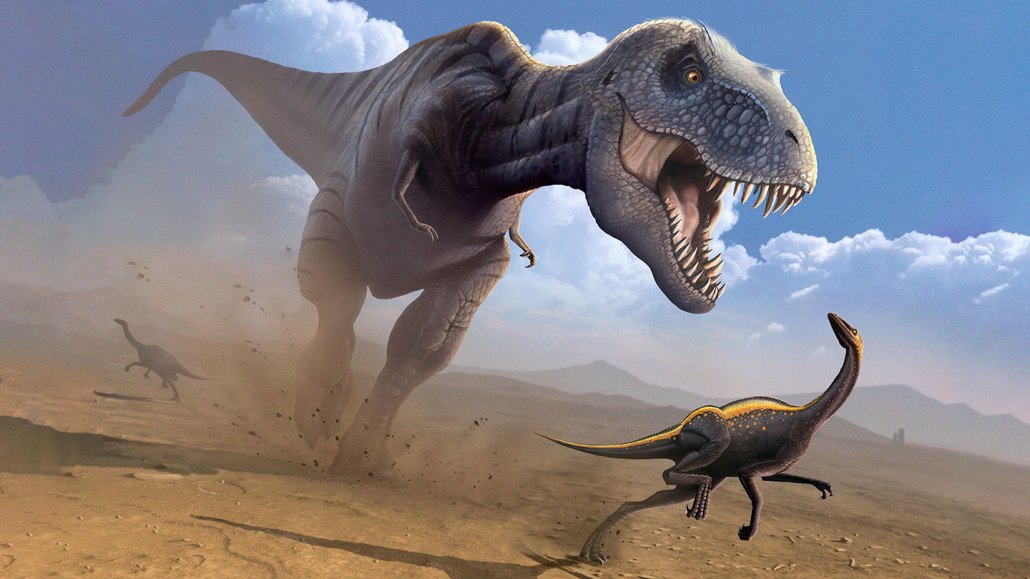
A T.rex chases a small dinosaur across a muddy flat.

If a dinosaur like T. rex ran on mud 100 million years ago, can we say how fast it was? Experiments with guinea fowl offer new clues.

Science Photo Library - MARK GARLICK/Brand X Pictures/Getty Images; adapted by L. Steenblik Hwang

To accompany New clues about dino speed come from birds strutting through mud

SCIENCE

Before Reading:

  1. Imagine running on wet sand as opposed to running on a sidewalk. Describe some differences between running on these two surfaces. Would one be easier to run on than the other? In what way do you expect either surface would affect running speed? Explain your answer.
  1. Imagine you are a scientist studying fossil footprints of long-extinct animals. Come up with two details about an extinct animal that you might infer based solely on those footprints. Explain what would lead you to draw those conclusions.

During Reading:

  1. Explain how footprints might help a scientist estimate running speed.
  2. Contrast the estimated running speed of Tyrannosaurus rex with that of Velociraptors based on equations developed by zoologist Robert McNeill Alexander. Include in your answer both the estimated running speed and the relative speed (how fast one moved relative to the other).
  3. The article mentions that the original equations ignored some important factors — or variables— that could affect running speed. Describe one missed variable related to the environment and how it might alter the results.
  4. Identify one variable ignored in the original equations that is related to the physiology — or the physical body— of the dinosaur.
  5. Describe two challenges encountered by the team who carried out the 10-year-old guinea fowl study.
  6. How did the movement of guinea fowl in the 10-year-old study differ from calculated estimates? How did researchers explain this difference?
  7. Explain how the guinea fowl study threw into question the accuracy of Robert McNeill Alexander’s equation.

After Reading:

  1. What does the article mean when it says that “lab math” doesn’t always add up in the real world?
  2. The article ends with the statement, “We might have to accept that we can’t know everything about an animal no one has ever actually seen.” Discuss this statement with a partner or small group. How do you think this relates to other fields of science? Do you think that we can only have a limited understanding of things we cannot see and/or directly measure?