Questions for ‘‘Superpuff‘ planets are as dense as cotton candy’
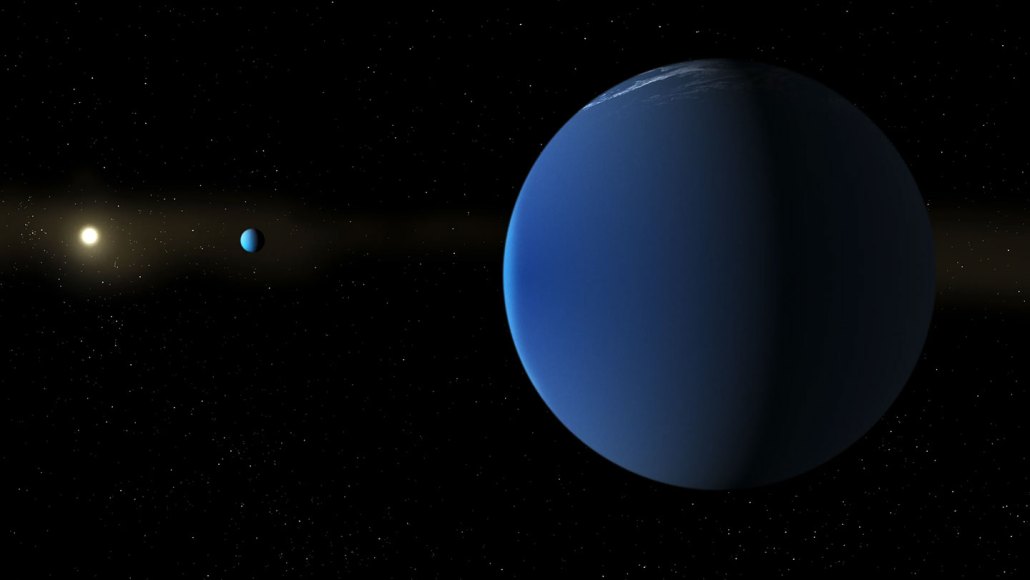
An illustration of two blue planets orbiting a faraway star.

Two newfound “superpuff” planets, illustrated orbiting a sunlike star over 1,000 light-years from Earth, are as big as Jupiter and as dense as cotton candy.

Daniel Rutter/NASA

To accompany “‘Superpuff‘ planets are as dense as cotton candy

SCIENCE

Before Reading:

1.  Describe the concept of density in your own words. Give an example of two familiar objects of somewhat similar size that differ greatly in their densities.

2.  Give two examples of data that scientists might collect to learn about distant objects in the night sky. For each example, explain what scientists might learn from those data about a distant star, galaxy or even a distant planet.

During Reading:

1.  How do the masses of the newly discovered “superpuff” planets compare to Jupiter’s mass?

2.  Name one analogy that researchers use to describe the density of the newly discovered planets.

3.  Compare the width of the newly discovered planets to Jupiter’s. Are the superpuff planets bigger, smaller or roughly the same size as Jupiter?

4.  Explain how researchers used the TESS space telescope to determine the radii of both newly discovered planets. What type of data did the telescope collect? Describe two different conditions under which the planets’ star — TOI 791 — must be observed to make the necessary calculations.

5.  Explain how researchers estimated the mass of both newly discovered planets.

6.  Give one reason why Antarctica is an optimal location for a telescope.

7.  What questions do scientists hope the James Webb Space Telescope will help answer about these planets?

After Reading:

1. The density of water is about 1 gram per cubic centimeter (at standard temperature and pressure). With a sufficiently large bathtub, would these newly discovered planets sink or float in water? Explain your answer.

2.  This story refers to various types of data that scientists collected to calculate an exoplanet’s mass and size. But other types of data not mentioned directly would have helped scientists, too. Consider what other measurements they might be. Give one example of another type of data that was not mentioned directly in this story that would have been useful to the researchers.