Questions for ‘The surface of Venus is morphing’
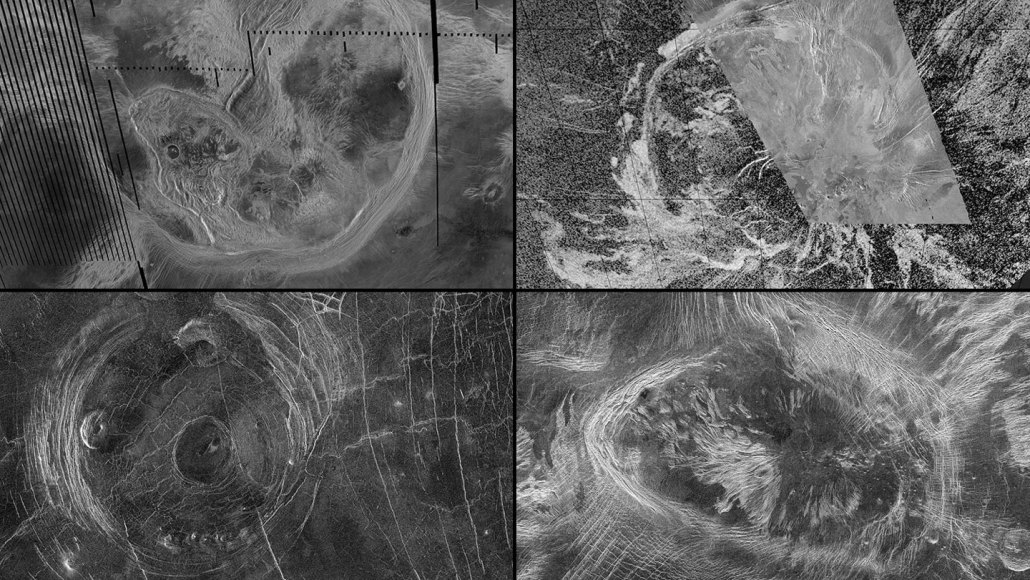
The 1989 Magellan spacecraft captured images on Venus of rounded mountain belts called coronae (four shown). A new analysis suggests these circular structures may signal tectonic activity.
JPL-Caltech/NASA
Share this:
- Share via email (Opens in new window) Email
- Share on Facebook (Opens in new window) Facebook
- Share on X (Opens in new window) X
- Share on Pinterest (Opens in new window) Pinterest
- Share on Reddit (Opens in new window) Reddit
- Share to Google Classroom (Opens in new window) Google Classroom
- Print (Opens in new window) Print
To accompany ‘The surface of Venus is morphing’
SCIENCE
Before Reading:
- Earth is a tectonically active planet, meaning sections of its outer crust move and shift. This causes continents and their geological features to change over time. Tectonic activity explains various processes and events, such as the presence of active volcanoes on Earth. Besides volcanoes, what is another process or event that might arise from plate tectonics?
- Imagine you leave your house one morning and discover that a deep hole has appeared overnight in your front yard. What is one theory you might come up with to explain the change? What is one type of data you could acquire, or an observation you could make, that would help test this theory?
During Reading:
- Define coronae. How are they different from Earth’s mountain ranges?
- What is the name of the layer that lies between a planet’s crust and its core?
- What is a computer model and how might it be of value to scientists? (Hint: Look to the Power Words at the end of this story for help.)
- How did scientists use a computer model to learn more about the surface of Venus?
- What did gravity data reveal about the properties of the material making up Venus’ mantle? What were scientists able to understand based on these data?
- Describe how the process of subduction typically works on Earth.
- How does the structure of the crust of Venus compare to that on Earth? How could subduction occur on Venus?
- What was the name of the spacecraft that collected Venusian gravity data in the 1990s? What is the name of the upcoming spacecraft that will expand upon these findings?
- Why are scientists excited about these findings? Name one question scientists are hoping to answer given these new insights.
After Reading:
- Draw a series of comic-strip-like images depicting how subduction might work on Venus. (There are a few versions of this process described in the story. Focus on one of these in your answer.) Include a short caption for each image. You should include at least three images in your sequence. Point to one piece of evidence described in this story to support your images.
- Scientists obtained valuable Venusian data decades ago. But only lately have they been able to use it to the extent seen in this study. What type of technological advance since the 1990s has made this type of investigation possible? Come up with one other potential application for how this type of technology might make use of old data in new ways.