Analyze This: What are the chances of an asteroid hitting Earth?
The odds of a big space rock striking the planet are higher than you might think
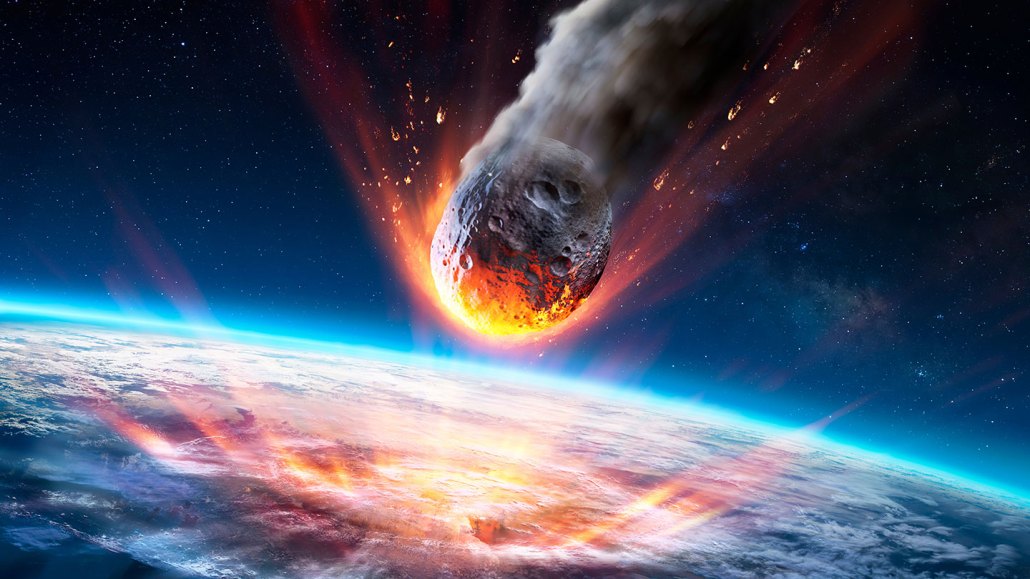
It’s not impossible for an asteroid to strike Earth during a person’s lifetime. In fact, it’s more likely than getting struck by lightning.
Romolo Tavani/Shutterstock
Our solar system is peppered with large rocks, called asteroids. If a big asteroid plummets to Earth, there are many possible outcomes. The space rock could splash into the ocean and not harm anyone, for instance. Or it could wipe out a city. People have a hard time understanding the chances of an asteroid strike. So a team calculated the likelihood and compared it with other events — with some surprising results.
“If a large or a medium asteroid were to hit the Earth, it would be something that almost everybody on the planet would be aware of,” says Carrie Nugent. She’s a planetary scientist at Olin College of Engineering in Needham, Mass. While killer asteroids have hit before, such as the one that finished off the dinosaurs 66 million years ago, Nugent says not to worry. “We try to put this event, which is actually a preventable event, in context with other preventable events.”
Nugent worked with six undergraduate students from Aalborg University in Denmark. Using a computer program, they simulated a group of asteroids similar to real near-Earth objects. They fed these modeled asteroids into a program called JPL Horizons. Anyone can use that program to look up predicted locations for objects in the solar system. For this project, the students determined whether each simulated asteroid would cross paths with Earth.
That allowed the team to estimate the frequency of asteroids bigger than 140 meters (460 feet) across. That’s around the size of a small cruise ship, Nugent says. An asteroid of this size would hit Earth roughly every 11,000 years. The researchers shared their findings August 12 in the Planetary Science Journal.
That number is still pretty hard to understand. So Nugent compared the chances of an asteroid hitting Earth with other events that people may experience. The chances of being alive during an asteroid strike, she found, are higher than that of being struck by lightning. But a person is more likely to die in a car crash.
Some events were rare but deadly. People — kids in particular — can die in dry sand hole collapses. This can happen when someone digs a large hole in sand, often at the beach. That hole can fall in on itself and take its digger down with it. “It is an extremely rare cause of death that most people don’t even know about,” Nugent says.
Books and movies often portray asteroid run-ins as unstoppable events. “The truth is actually entirely the opposite,” she says. NASA’s DART Mission in 2022, for instance, bopped an asteroid that wasn’t in danger of hitting Earth. The test changed the asteroid’s path. This showed that people might be able to do this one day with a rock headed for our planet and avert a collision. So, Nugent says, it’s important to do research, such as sky surveys, that locate these objects. “This is the one natural disaster we can totally prevent,” she says.
Rare, Preventable Events
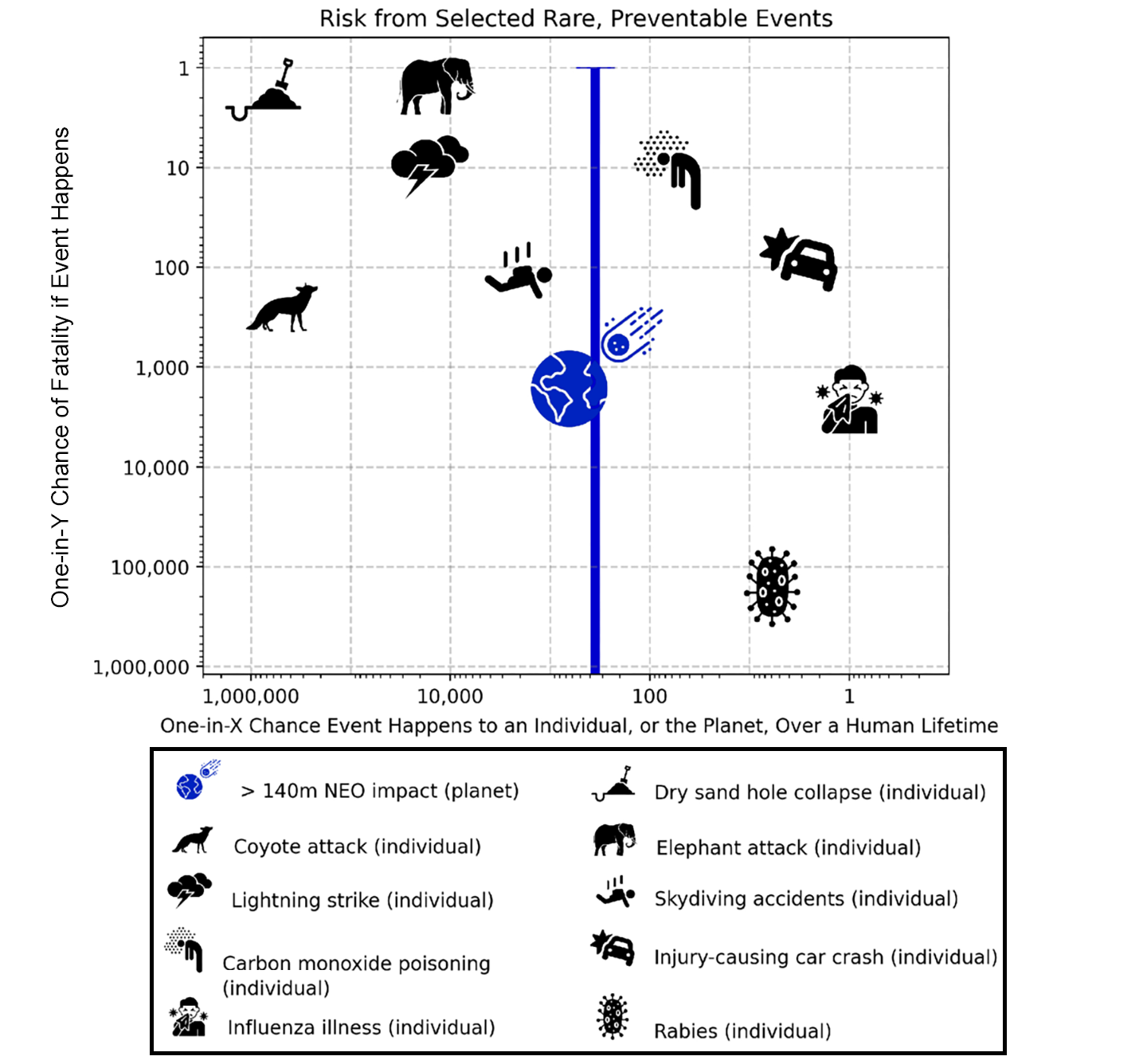
Nugent’s team calculated the chances of near-Earth object (NEO), such as asteroids, hitting Earth in a person’s lifetime. They compared this with the likelihood of other preventable events. The chance of an asteroid hitting the Earth is shown by the blue marker. The chance of such an asteroid killing a person is shown by the vertical blue bar.
The graph is presented on a logarithmic scale. That means each grid line differs by a factor of ten from the one next to it. The x-axis gives the one-in-X chance that an event happens to an individual or the planet. For instance, the chance of being hit by lightning is 1-in-11,000. The y-axis gives the one-in-Y chance that a person dies if the event happens. So someone hit by lightning has a 1-in-10 chance of dying.
Unlike most graphs, the label numbers on the x-axis get smaller moving to the right. And on the y-axis, they get smaller going up. This is because a one-in-X number is like a fraction with “1” on top and the “X” number on the bottom. The bigger the label number on these axes, the smaller the likelihood of that event happening.
Data Dive:
- Which of the listed events is the most likely to happen during a person’s lifetime? What is the chance of it occurring?
- Which of the listed events is the least likely to happen during a person’s lifetime?
- What is the chance of an asteroid hitting Earth during a human’s lifetime?
- If a person were to contract rabies, what’s the likelihood they would die from it? What about influenza?
- Why do you think that the bar showing the chance of fatality from an asteroid is so large?