HS-ESS1-2
Construct an explanation of the Big Bang theory based on astronomical evidence of light spectra, motion of distant galaxies, and composition of matter in the universe.
- Planets
Astronomers may have found first known planet in another galaxy
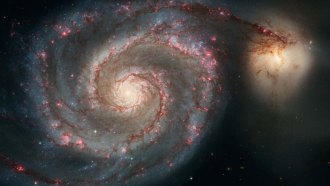
The spiral-shaped Whirlpool galaxy may be home to the first planet spotted outside our own Milky Way galaxy.
- Life
Let’s learn about the hunt for alien life
Finding any extraterrestrials, from advanced alien civilizations to simple microbes, would be an unmatched discovery.
- Planets
NASA’s Perseverance rover grabbed its first Martian rocks
Two finger-sized pieces of stone drilled from a basalt rock are the first bits of Mars ready to be brought to Earth.
- Planets
Pluto is no longer a planet — or is it?
In the 15 years since Pluto lost its status as a planet, some scientists continue to use whatever definition works best for them.
- Space
Here’s an easier new way to weigh a black hole
The timing of flickers in the gas and dust of a black hole’s accretion disk correlates to its mass, a new study finds.
- Earth
Let’s learn about meteor showers
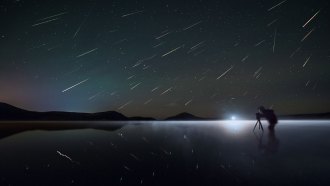
Meteor showers happen when Earth’s orbit passes through trails of debris left behind by comets or asteroids.
- Planets
Jupiter’s intense auroras heat up its atmosphere
Jupiter’s hotter-than-expected upper atmosphere may be warmed by charged particles slamming into the air above the poles.
- Physics
Let’s learn about dark matter
Dark matter is only detectable by the gravitational pull it exerts on visible objects, like stars and galaxies.
- Planets
This image may be the first look at exomoons in the making
These observations offer some of the best evidence yet that planets around other stars have moons, or exomoons.
- Planets
Born in deep shadows? That could explain Jupiter’s strange makeup
Dust that blocked sunlight might have caused the gas giant to form in a deep freeze, a new study suggests.
- Space
Cosmic filaments may have the biggest spin in outer space
These rotating threads of dark matter and galaxies stretch millions of light-years. Scientists want to know how their spin begins.
- Physics
Spin in this Milky Way bar may show cosmic dark matter does exist
A method akin to studying a tree’s rings reveals the timeline of a slowdown in those stars at the heart of our Milky Way galaxy.