HS-ESS1-4
Use mathematical or computational representations to predict the motion of orbiting objects in the solar system.
- Space
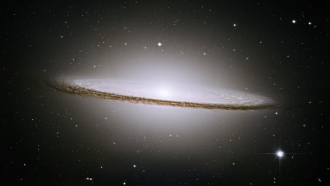
This ‘Sombrero’ stole a big galaxy
The Sombrero Galaxy is an odd spiral galaxy that outshines all others within 35 million light-years of Earth. Its bright, iron-rich halo suggests it consumed one or more large galaxies.
- Physics
Dust-shrouded monster is a snapshot from the early universe
Scientists have spotted a massive galaxy from the early universe shrouded in dust. It turned up in a small survey by the ALMA radio telescopes in Chile.
- Physics
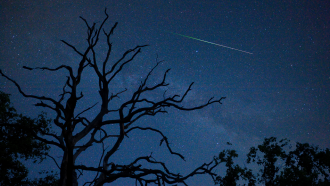
Explainer: Understanding meteors and meteor showers
Meteors regularly enter Earth’s atmosphere. Most ‘shooting stars’ pose few risks to life on the ground, but the rare big ones can be lethal.
- Physics
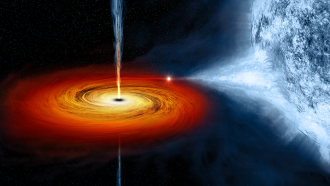
Explainer: What are black holes?
Among the most extreme celestial bodies in the universe, black holes are dense, massive entities whose gravity can sometimes hold together an entire galaxy.
- Physics
Disabilities don’t stop these experts in science and tech
People with disabilities are as varied as the careers some of them pursue in science, technology, engineering and math.
- Planets
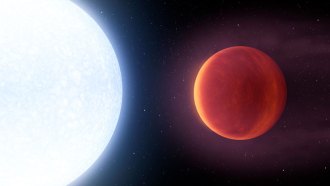
Hot, hot planet sets sizzling new record
Astronomers have discovered an odd new exoplanet. Called KELT 9b, is the hottest non-star known.
- Space
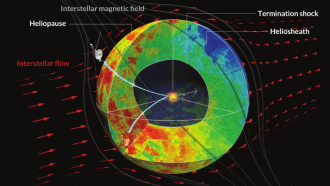
How the solar system’s tail disappeared
A bubble envelops the planets and other material in the solar system. New data show it does not have a long tail but is round.
- Physics
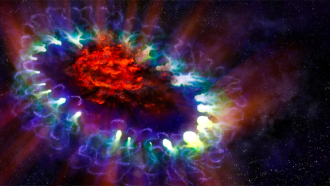
After 30 years, this supernova is still sharing secrets
It’s been 30 years since astronomers first witnessed the stellar explosion known as SN 1987A. Today, researchers are still learning from this cataclysmic phenomenon.
- Physics
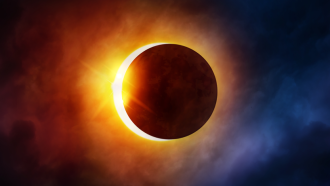
Eclipses come in many forms
Eclipses are one of nature’s most awesome spectacles, and scientists have learned a lot by observing them and related celestial alignments — occultations and transits.
- Earth
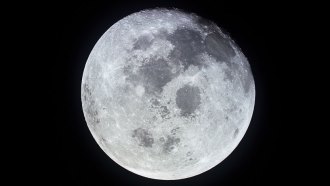
How Earth got its moon
How did our moon form? Scientists are still debating the answer. It may be the result of some one big impact with Earth — or perhaps many small ones.
- Science & Society
Cool Jobs: Reaching out to E.T. is a numbers game
From figuring out if we’re alone in the universe, to writing messages to aliens, scientists use math in many ways in their search for extraterrestrial intelligence.
- Planets
Scientists Say: Dwarf planet
Dwarf planets are distinct from the full-size models. A little too small, they also have a lot of space stuff filling their path around the sun.