HS-ESS1-4
Use mathematical or computational representations to predict the motion of orbiting objects in the solar system.
- Physics
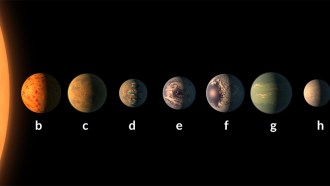
New solar system found to have 7 Earth-size planets
A neighboring star system hosts seven Earth-like planets. Especially surprising: Three of those planets appear to reside in a zone that could support life as we know it.
- Planets
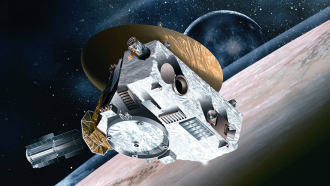
Cool Jobs: Probing Pluto
The New Horizons mission captivated the world as it flew by Pluto. Here are some of the people who made that possible.
- Space
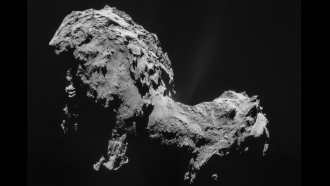
Scientists Say: Comet
Comets are small solar system objects. When they pass close to their sun, their melting gases and water give them a tail.
-
Scientists consider how to visit the closest exoplanet
Even at only a little more than four light-years away, a trip to our closest exo-world could take some tens of thousands of years — unless we’re willing to settle for virtual visits.
- Planets
Jupiter’s Great Red Spot is really, really hot
The Great Red Spot, a storm churning on Jupiter for at least 150 years, may be helping to keep the planet warm, a new study finds.
- Space
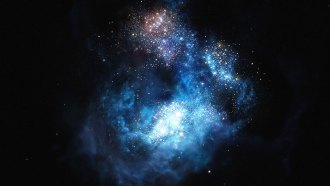
A new, nonexplosive source of black holes?
At least one black hole may have formed from the collapse of a cloud of gas, which is not the usual birthing scheme. This might even be how some of the earliest gargantuan black holes developed.
- Planets
New clues in search for Planet Nine
New details about Planet Nine, a hypothetical object on the edge of our solar system, might help scientists actually find it.
- Planets
Juno’s knocking on Jupiter’s door
The Juno spacecraft will peer into Jupiter’s clouds and fly in close to its monstrous auroras.
- Physics
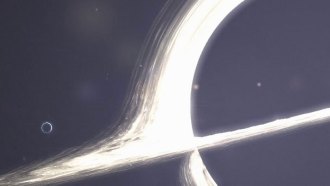
Spinning black holes may ‘sing’ during a collision
The massive black hole in the movie Interstellar would create a unique gravity-wave signal when gobbling a smaller partner.
- Physics
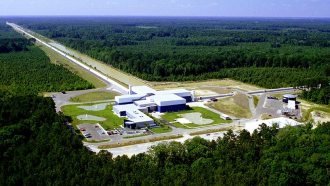
Gravity waves detected at last!
Albert Einstein predicted gravitational waves 100 years ago. Now scientists have detected them coming from the collision of two black holes.
- Physics
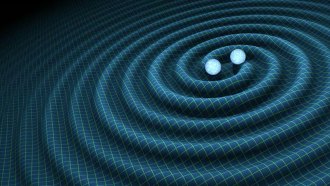
Explainer: What are gravitational waves?
Albert Einstein had predicted that large catastrophes, like colliding black holes, should produce tiny ripples in the fabric of space. In 2016, scientists reported finally detecting them
- Planets
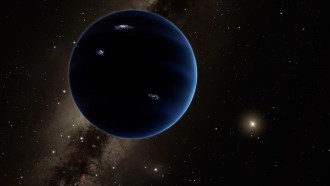
Beyond Pluto: A new 9th planet?
A giant planet, perhaps 10 times Earth’s mass, may be orbiting the sun from a great distance. Its existence, orbit and size are all surmised, based on strange effects seen in objects within the distant Kuiper Belt.