HS-ESS1-4
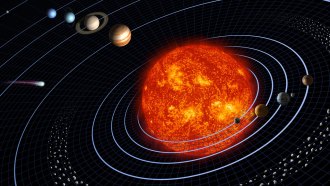
Use mathematical or computational representations to predict the motion of orbiting objects in the solar system.
- Science & Society
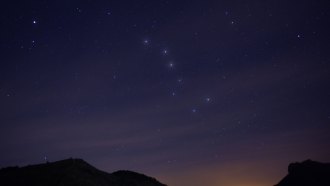
Here’s why people picked certain stars as constellations
Patterns of human eye movement help explain why particular sets of stars form iconic shapes, a high school student showed.
- Space
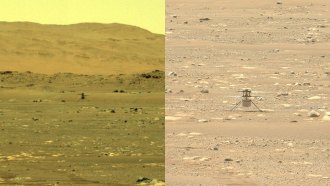
Ingenuity helicopter makes history by flying on Mars
The copter's 40-second-long flight in the Red Planet’s thin air is only the first in a planned series of daring flights.
- Planets
Scientists Say: Planet
Planets have to orbit a star, be big enough to form a sphere and keep other objects out of their path around their star.
- Planets
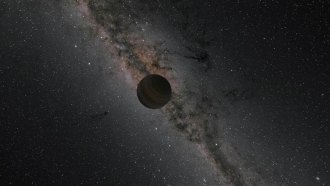
Rogue planets wander the galaxy all alone
Some planets don’t orbit stars. They were kicked into space long ago. The newest, smallest one found is only about as massive as Earth.
- Math
Meet ‘Pi’ — a new Earth-sized planet
Searching through data from NASA’s K2 Mission, researchers found a new planet. Some call it K2-315b, others smile and refer to it as “Pi Earth.”
- Physics
2020 Physics Nobel goes for delving into black holes
Although Einstein’s general theory of relative suggested black holes might exist, this year’s winner’s helped show they actually are out there.
- Space
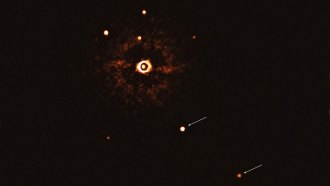
A weird cousin of our solar system is caught on camera
New photo reveals a cousin to our solar system. It’s star has a mass similar to the sun’s and is orbited by two gas giant planets.
- Physics
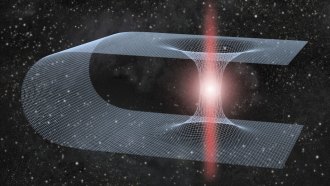
Could ripples in spacetime point to wormholes?
A new calculation reveals that strange gravitational waves detected by LIGO and Virgo could see if a black hole were falling into a hypothetical tunnel in spacetime.
- Physics
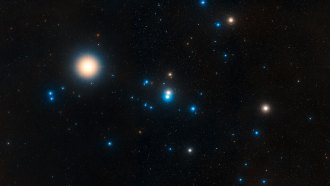
Milky Way’s tidal forces are shredding a nearby star cluster
The nearest star cluster is being pulled apart, due largely to the tidal forces of our galaxy, the Milky Way. Bye bye, Hyades!
- Physics
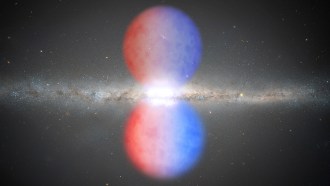
Spotted: Milky Way’s giant gas bubbles in visible light
The bubbles have different colors, based on how the gas inside them moves. That could give clues to how the bubbles developed.
- Space
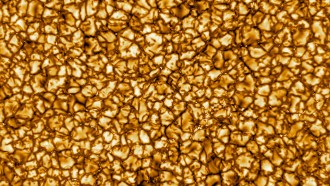
See the sun in dazzling detail
These images show the sun as it has never been seen before. They come from the new Daniel K. Inouye Solar Telescope.
- Space
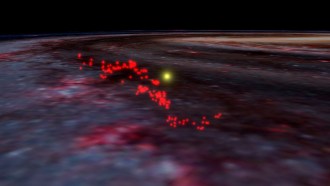
Our sun is neighbor to a giant wave of gas
The Earth and sun sit relatively close to a newfound thread of star-forming gas. That gas is being called the Radcliffe Wave.