ancestor: A predecessor. It could be a family forebear, such as a parent, grandparent or great-great-great grandparent. Or it could be a species, genus, family or other order of organisms from which some later one evolved. For instance, ancient dinosaurs are the ancestors of today's birds. (antonym: descendant)
archeologist: (also archaeologist) The study of human history and prehistory through the excavation of sites and the analysis of artifacts and other physical remains. Those remains can range from housing materials and cooking vessels to clothing and footprints. The field these people work in is known as archeology.
artifact: Some human-made object (such as a pot or brick) that can be used as one gauge of a community’s culture or history. (in statistics or experiments) Something measured or observed that is not naturally a part of some system. It was instead introduced accidentally as a result of how the measurement or study was performed.
calcium: A chemical element and alkali metal common in minerals of the Earth’s crust and in sea salt. It is also found in bone mineral and teeth, and can play a role in the movement of certain substances into and out of cells.
environment: The sum of all of the things that exist around some organism or the process and the condition those things create. Environment may refer to the weather and ecosystem in which some animal lives, or, perhaps, the temperature and humidity (or even the placement of things in the vicinity of an item of interest).
extract: (v.) To separate one chemical (or component of something) from a complex mix.
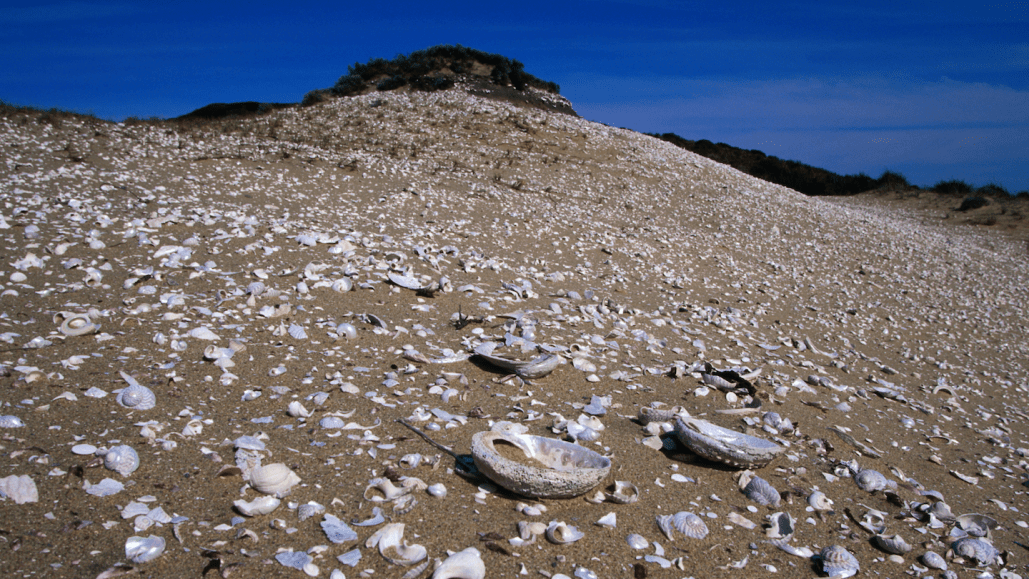
midden: A waste heap or dump site for trash and bodily wastes. They have been associated with both human and animal colonies.
mineral: Crystal-forming substances that make up rock, such as quartz, apatite or various carbonates. Most rocks contain several different minerals mish-mashed together. A mineral usually is solid and stable at room temperatures and has a specific formula, or recipe (with atoms occurring in certain proportions) and a specific crystalline structure (meaning that its atoms are organized in regular three-dimensional patterns).
rodent: A mammal of the order Rodentia, a group that includes mice, rats, squirrels, guinea pigs, hamsters and porcupines.
sea: An ocean (or region that is part of an ocean). Unlike lakes and streams, seawater — or ocean water — is salty.
shell: The normally hard, protective outer covering of something. It could cover a mollusk or crustacean (such as a mussel or crab), a bird’s egg or some other relatively soft tissue that needs protection (such as a tree nut or peanut).
tool: An object that a person or other animal makes or obtains and then uses to carry out some purpose such as reaching food, defending itself or grooming.
unique: Something that is unlike anything else; the only one of its kind.