HS-PS4-5
Communicate technical information about how some technological devices use the principles of wave behavior and wave interactions with matter to transmit and capture information and energy.
- Animals
Elusive worm-lizards sport weird, spooky skulls
CT scans of these mysterious creatures turned up bizarre internal features. They could offer clues about amphisbaenians’ largely unknown behavior.
- Physics
Neutrons are unveiling hidden secrets of fossils and artifacts
Images made with these particles have revealed details of dinosaur bones, mummies and more.
- Physics
A new tool shows tiny changes in the ’24-hour’ length of a day
An underground instrument known as ‘G’ uses laser beams to measure Earth’s rotation — a gauge of day length — with extreme precision.
- Planets
In a first, astronomers spot the aftermath of an exoplanet smashup
Infrared light from a distant star appears to be leftovers of an impact between a pair of Neptune-sized worlds.
- Tech
Nanobots can now enter brain cells to spy on what they’re doing
Fleets of advanced versions may one day be able to detect disease and then go about surgically treating it — without ever opening the skull.
- Tech
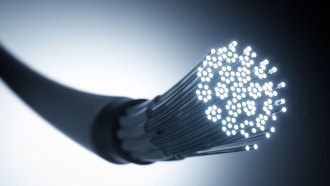
Scientists Say: Fiber optic cable
Whether you’re reading these words on a phone, computer or other device, you may have fiber optic cables to thank.
- Tech
Gravity ‘batteries’ might help a weighty renewable-energy problem
To store the energy generated by wind and solar power, researchers are looking at mammoth systems that raise and lower weights.
- Computing
A single chip like this could transmit a world’s worth of data
The internet has a big environmental footprint. But this new type of tech could help reduce the climate impact of computing.
- Computing
Sleep helps AI models learn new things without forgetting old ones
Breaks in training meant to mimic human sleep helped artificial intelligence learn multiple tasks.
- Computing
Scientists Say: Artificial intelligence
Artificial intelligence is technology smart enough to do tasks that would normally require human brainpower.
- Tech
Will the internet soon reach the one-third of people without it?
Access to the internet is a human right, yet much of the world can’t get online. New tech has to be affordable and usable to end this digital divide.
- Tech
A tool as small as a human cell can scan for contaminants and more
Tiny spectrometers might someday show up on smart devices. They could help people scan for ingredients or contaminants in foods and other materials.