MS-PS4-2
Develop and use a model to describe that waves are reflected, absorbed, or transmitted through various materials.
- Earth
Earthquake sensor: Taylor Swift fans ‘Shake It Off’
Scientists determined dancing fans were behind the seismic waves recorded during Swift’s August concerts.
- Earth
Explainer: Sprites, jets, ELVES and other storm-powered lights
Fleeting glows collectively known as “transient luminous events” flash in the skies above powerful lightning storms.
- Oceans
Analyze This: Climate change may worsen the spread of ocean noise
Some parts of the ocean may become five times as loud in the future.
- Earth
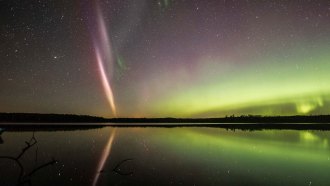
The weird sky glow called STEVE is really confusing scientists
Researchers are trying to figure out the recipe of atmospheric conditions that creates this aurora-like light show.
- Space
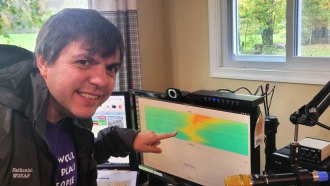
This space physicist uses radios to study eclipses
Nathaniel Frissell uses radio data to study how eclipses affect a layer of the atmosphere called the ionosphere.
- Physics
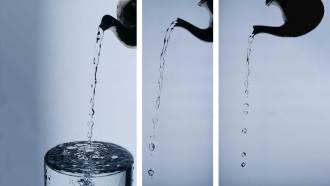
Physics explains why poured water burbles the way it does
The loudness of falling water depends on the height of the pour and the thickness of the stream.
- Physics
Scientists Say: Polarized light
Sunlight, lamplight and other lights are usually unpolarized. But passing light waves through filters can ‘polarize’ them.
- Physics
Neutrons are unveiling hidden secrets of fossils and artifacts
Images made with these particles have revealed details of dinosaur bones, mummies and more.
- Archaeology
Analyze This: Stonehenge’s ‘Altar Stone’ has mysterious origins
After a century of searching for the source of the Altar Stone, scientists have yet to figure out where ancient people got the rock.
- Physics
A new tool shows tiny changes in the ’24-hour’ length of a day
An underground instrument known as ‘G’ uses laser beams to measure Earth’s rotation — a gauge of day length — with extreme precision.
- Tech
Bionic plants and electric algae may usher in a greener future
Some can aid the climate by removing pollutants. Others would just avoid dirtying the environment in the first place.
- Planets
In a first, astronomers spot the aftermath of an exoplanet smashup
Infrared light from a distant star appears to be leftovers of an impact between a pair of Neptune-sized worlds.