MS-PS4-2
Develop and use a model to describe that waves are reflected, absorbed, or transmitted through various materials.
- Physics
Physics finally explains the sound of clapping
The “Helmholtz resonator” concept is responsible for the sound produced by hand-clapping.
- Microbes
Living lenses? Glass-coated microbes might take better photos
Bacteria with a gene from sea sponges can coat themselves in glass. Working as tiny, bendable lenses, they could lead to thinner cameras or sensors.
- Materials Science
Orange food dye can temporarily turn skin transparent
When mixed with water and rubbed on the skin, a common food dye allows researchers to peer inside the body of a mouse.
- Earth
Analyze This: Why do atmospheric ‘ghosts’ glow green after red sprites?
Green ghosts — blurs of light that sometimes follow lightning — get their color from oxygen and metals in space dust.
- Physics
Experiment: Making music with bottles
In this study, we investigate how the volume of air inside a bottle affects the pitch of the musical notes it can create.
- Humans
Experiment: Why does the moon look larger on the horizon?
In this experiment, let’s investigate Emmert’s law, which may explain the full moon optical illusion.
- Space
Scientists Say: Astronomical interferometry
This technique links up many telescopes to see the universe in finer detail than any single telescope could alone.
- Physics
Experiment: Measure the speed of light with a laser
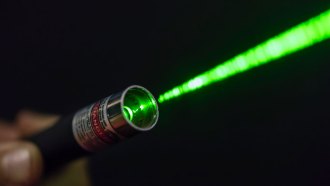
Grab a laser pointer and some Jell-O, because today we’re measuring the speed of light.
- Plants
Flowers may electrically detect bees buzzing nearby
The discovery may reveal how plants time nectar production and share information with neighboring blooms.
- Space
Here’s how to build an internet on Mars
Future Red Planet residents will need to get online to talk to each other and Earth. But that will require a lot of new tech.
- Physics
Let’s learn about particles that help us peer inside objects
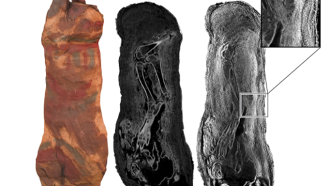
Particles such as muons, X-rays and neutrons help scientists peer inside fossils, mummies, pyramids, volcanoes and the human body.
- Space
Check out the magnetic fields around our galaxy’s central black hole
Astronomers have captured polarized light coming from the Milky Way’s supermassive black hole. This offers insight into its magnetic fields.