Waves and Their Applications in Technologies for Information Transfer
- Physics
Scientists Say: Watt
Say Watt? This is a unit used to measure the flow of energy being used.
- Brain
When smartphones go to school
Students who use smartphones and other mobile technology in class may well be driven to distraction. And that can hurt grades, studies show.
- Physics
Gravity waves detected at last!
Albert Einstein predicted gravitational waves 100 years ago. Now scientists have detected them coming from the collision of two black holes.
- Physics
Explainer: What are gravitational waves?
Albert Einstein had predicted that large catastrophes, like colliding black holes, should produce tiny ripples in the fabric of space. In 2016, scientists reported finally detecting them
- Physics
How to catch a gravity wave
Physicists have just announced finding gravity waves. The phenomenon was predicted a century ago by Einstein’s theory of general relativity. Here’s what it took to detect the waves.
- Earth
Bubbles may have sheltered Earth’s early life
For Earth’s earliest inhabitants, a bubble on the beach would have been the next best thing to a safety blanket.
- Earth
News Brief: Why rainbows can lose some hues
When the sun is right near the horizon, such as at sunset, its light travels through the most atmosphere. When there’s also plenty of water in the air, this can rob colors from a rainbow, scientists now report.
- Physics
Boom! Sounding out the enemy
Armistice Day marked the end of the Great War. But what arguably won the war was acoustics — the science of sound. It allowed Allied troops to home in on and rout the enemy.
- Physics
Einstein taught us: It’s all ‘relative’
One hundred years ago, a German physicist shared some math he had been working on. In short order, his theory of relativity would revise forever how people viewed the universe.
- Earth
Explainer: What is a tsunami?
Earthquakes and landslides can create huge waves that travel across oceans.
- Earth
Ground-thumping cheers help scientists
Eager to test new sensors before the next ‘big one,’ earthquake scientists make use of a predictable source of ground-shaking: football fans.
- Tech
This door handle kills germs
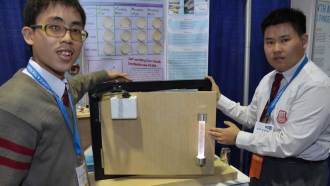
A high-tech door handle may cut down on disease transmission, say its teen developers. The system is powered by simply opening and closing the door.