Humans
- Earth
Fracking wastes may be toxic, tests show
Fracking operations have been polluting the environment. Some wastes have hormonal effects. Studies in mice now show that prenatal exposures to these wastes can trigger subtle but disturbing organ impacts.
- Animals
Secrets of slime
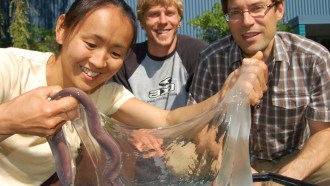
Mucus—snot—can be so gross. It’s also critical for many animals, including hagfish, snails and people. Snot can rid our bodies of nasty bacteria and viruses. In other creatures, it can smooth the road or rough up predators.
- Humans
Neandertals create oldest jewelry in Europe
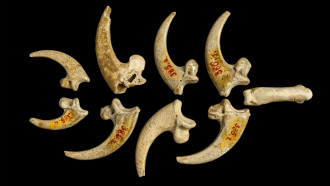
Adorned with all-natural signs of power: eagle claws. Holes in these claws show that Neandertals had been strung them together, like beads, as jewelry.
- Health & Medicine
Stress for success
Stress and anxiety can lead to serious mental and behavioral problems. Identifying stressors can help people cope with anxiety. Even better, viewing stress as a strength can tone down anxious feelings and boost productivity.
- Health & Medicine
Chickens spread latest deadly bird flu
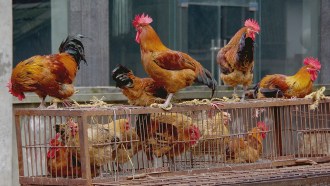
A new bird flu virus threatens to spread outside of China. Experts traced the germ to markets where live chickens are sold.
- Health & Medicine
Replacement ‘plastic’ may be as risky as BPA
Bisphenol chemicals are the basic building block of many common plastics. Some governments have banned BPA from baby bottles. But mounting evidence suggests that its replacement, BPS, may be no safer.
- Health & Medicine
Scientists Say: Circadian
We often feel the pull of sleep when the sun goes down. Light and our own biology put us into a regular, 24-hour rhythm that has its own word.
- Health & Medicine
How hot peppers can soothe pain
Peppers can burn the tongue, but soothe sore tissues. Scientists have now sleuthed out how, and the answer shows a role for stretch sensors on cells.
- Animals
Eyelashes: The ‘sweet’ length
New mathematical and aerodynamics studies find what seems to be the optimal length for eyelashes — the length that protects best. And surprise: Longer is not always better.
- Genetics
Mice can teach us about human disease
Humans and mice look and act very differently. But 85 to 90 percent of their genes are the same or quite similar. So an international group of scientists is deciphering the instructions in mouse genes to help us better understand our own.
- Health & Medicine
Peanuts for baby: A way to avoid peanut allergy?
Making peanut products a baby food could head off life-threatening peanut allergies later, new data show.
- Psychology
Scientists Say: Pareidolia
We often see things that aren’t there, such as bunnies in clouds or faces in toast. They aren’t real, but they do have a special name