Life
- Animals
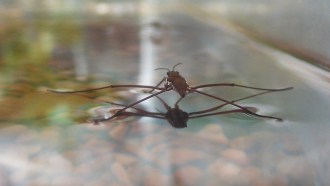
Teen studies water strider disappearing act
As a child, Xidian Zhang loved to play with water striders. Now they’re gone, and pollution may be the reason. This teen’s findings earned him a spot at the 2014 Intel International Science and Engineering Fair.
- Animals
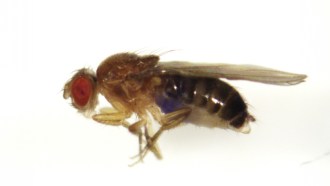
A science fair project makes bug killing sweet
Simon Kaschock-Marenda wanted to see how flies responded to different sweeteners. Along the way, he discovered an insecticide that would pose little risk to people. And the 14-year-old is now a published author on a scientific paper.
- Animals
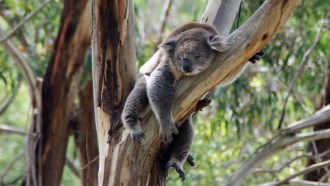
Trees: Koala air conditioning
When koalas sprawl over a tree branch, they may not be lazy. They just might be taking advantage of some natural cooling — enough to survive a heat wave.
- Plants
Taking a long look at lichen
Lichens may not look like much, but they play a vital role in our ecosystems. ISEF finalist Madeline Handley decided learn more about the lichens in her native Alaska.
- Animals
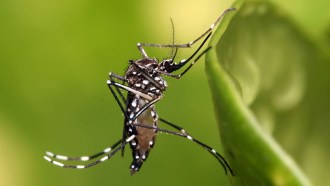
Mosquitoes, be gone!
An extract of local seeds in Puerto Rico may be the key to keeping mosquitoes away. It kills the larval insects and repels the biting adults.
- Brain
Football hits the brain hard
The brain’s hippocampus helps store memories. It is smaller in college football players — especially if they have suffered concussions.
- Animals
Killing mosquitoes with cashews
When dengue fever came to his hometown, Gabriel Galdino looked for ways to stop its carrier, the mosquito. His findings got him a spot at the 2014 Intel International Science and Engineering Fair.
- Microbes
Convincing bacteria they’re alone
Caffeine may be the trick to confusing some bacteria into thinking they’ve not yet summoned enough troops to launch a successful attack on their host. It could prove an alternative to antibiotics for certain infections.
- Animals
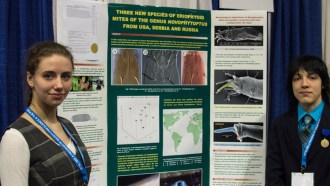
Mite-y discoveries!
Two teens from Russia discovered tiny mites living inside grass-like plants called rushes. Three of the species they turned up are new to science.
- Animals
Electronics may confuse a bird’s ‘compass’
Birds use Earth’s magnetic field to help guide them as they migrate. A new study suggests that electromagnetic radiation given off by some electronic devices may act like “noise” and confuse the long-traveling birds.
- Animals
Even penguins get the flu
Scientists have just identified ‘live’ bird flu virus in Antarctic penguins. But the infections may not be novel. There are some signs these germs have been infecting local wildlife for up to 80 years.
- Animals
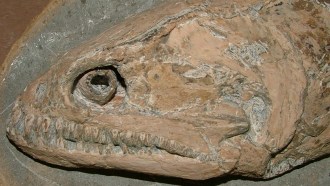
Surprise! Fossils in a flash
By studying how dead tissues decay — or turn to ‘instant’ fossils — scientists are gleaning helpful clues to what ancient life looked like.