Physics
- Archaeology
Scientists detect mystery void in Great Pyramid of Giza
Using high-tech tools normally reserved for studies in particle physics, scientists have found a large, hidden void inside Egypt’s Great Pyramid of Giza.
- Physics
Ancient light may point to where the cosmos’ missing matter hides
The universe is missing some of its matter. Now astronomers may have a way to find it.
- Physics
Teen identifies way to detect failing underground pipes
A teen researcher uses acoustics — here, pipe vibrations — to test whether buried water pipes are about to fail, and leak.
- Genetics
One day, your sunscreen may be made from DNA
A new approach to sunscreen could use a thin layer of DNA to protect skin cells — and hopefully prevent cancer.
- Materials Science
You can peel permanent marker, intact, off of glass
The surface tension of water can essentially scrape a thin film of some water-repellent material — such as permanent ink — off of glass.
- Chemistry
Scientists Say: Gradient
This is a word used to describe the rate that something changes over a distance or time. Examples include the strength of a smell or the steepness of a mountain.
- Chemistry
U.S. Army is developing high-tech underwear
A new fabric could warm the skin of active soldiers in cold climates. At the same time, it could soak away sweat that might otherwise cause chills.
- Physics
Astronomers finally find the cosmic source of gold and silver
After a collision between neutron stars is caught rippling spacetime, telescopes home in on where the ripples came from. The afterglow of light they found provided interesting new science.
- Chemistry
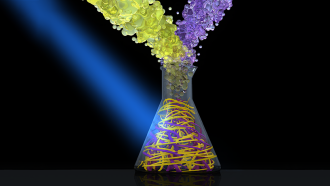
Blue light flexes its chem-building muscle
Scientists found a new way to build a strong but bendable blend of polymers. The trick? Expose the ingredients to a beam of blue light.
- Chemistry
Explainer: What are polymers?
Polymers, whether natural or artificial, are big molecules made by linking up smaller repeating chemical units. The most common “backbones” for polymers are chains of carbon or silicon, each of which can bond to four other atoms.
- Computing
Scientists Say: Radar
This is a system used to detect objects large and small. It works by sending out radio waves and waiting for them to bounce back.
- Chemistry
Specially coated fabric could turn a shirt into a shield
Specially treated fabrics offer a new kind of defense against chemical attacks. It could protect troops — and people living in war-torn nations where chemical weapons may be used.