Space
- Planets
Analyze This: Some 5,000 planets orbit stars other than our sun
A new cache of confirmed exoplanet discoveries marks a milestone in planets found beyond our solar system.
- Physics
Explainer: All about orbits
A handful of rules can describe the route some object repeatedly takes around another in space. Calculating that path, however, can be quite complex.
- Earth
Scientists Say: Atmosphere
An atmosphere is an envelope of gas around a planet, dwarf planet or moon.
- Space
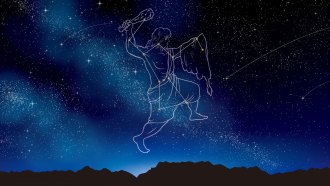
Scientists Say: Constellation
Constellations are clusters of related things, especially the stars that form patterns in the night sky — some of which date back to ancient times.
- Planets
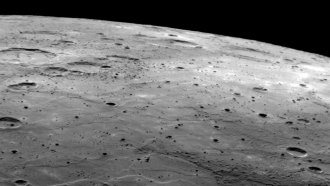
Mercury’s surface may be studded with diamonds
Billions of years of meteorite impacts may have transformed much of Mercury's graphite crust into precious gemstones.
- Planets
Let’s learn about Pluto
Once known as a pipsqueak planet, Pluto is now the solar system’s best known dwarf planet.
- Tech
Space trash could kill satellites, space stations — and astronauts
As private companies prepare to sprinkle space with tens of thousands of satellites, experts worry about the mushrooming threat of space junk.
- Physics
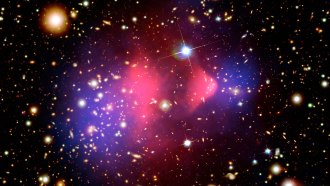
Scientists Say: Dark Energy
Dark energy is the unknown force causing the universe to expand faster and faster.
- Physics
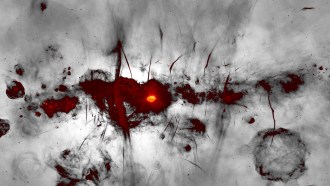
Wild art? No, it’s a radio image of the heart of our Milky Way
Eyelash-like radio filaments accent the brightest feature in this image — a supermassive black hole.
- Chemistry
No, organic molecules alone don’t point to life on Mars
These carbon-based molecules, found in a meteorite, may reflect merely a mixing of water and minerals on the Red Planet over billions of years.
- Health & Medicine
Here’s how a new sleeping bag could protect astronauts’ eyesight
A new sleeping bag could avoid vision problems on long space flights due to microgravity. It counters a fluid buildup behind astronauts’ eyes.
- Environment
Explainer: Gravity and microgravity
The force of gravity holds us on the ground, keeps planets in orbit and extends throughout space. A very weak gravitational pull is called microgravity.