Space
- Space
Scientists Say: Corona
The sun’s corona can only be seen without special instruments during a total solar eclipse.
- Earth
Get ready for the 2024 total solar eclipse
A total solar eclipse will race across North America on April 8, 2024, providing a rare opportunity for both scientists and casual observers.
- Space
Let’s learn about meteorites
Meteorites are bits of space rock that have crash-landed on Earth — or on another celestial body.
- Space
Scientists Say: Solar Cycle
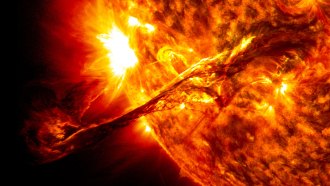
This roughly 11-year cycle in the sun’s activity can affect space weather that messes with Earthly technology.
- Earth
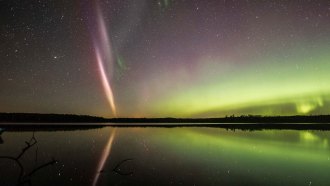
The weird sky glow called STEVE is really confusing scientists
Researchers are trying to figure out the recipe of atmospheric conditions that creates this aurora-like light show.
- Space
This space physicist uses radios to study eclipses
Nathaniel Frissell uses radio data to study how eclipses affect a layer of the atmosphere called the ionosphere.
- Planets
Huge polygons on Mars hint its equator may once have been frozen
A Chinese rover used radar to reveal long-buried terrain. The discovery hints that Mars’ equator was once much colder and wetter.
- Planets
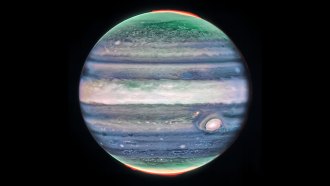
Jupiter has a never-before-seen jet stream — and it’s speedy
Spotted in images from the James Webb telescope, the high-altitude current may help untangle the workings of the giant planet’s atmosphere.
- Space
Black holes and activism inspire this astrophysicist
Mallory Molina is looking for supermassive black holes — and helping others find their place in the field of astronomy.
- Space
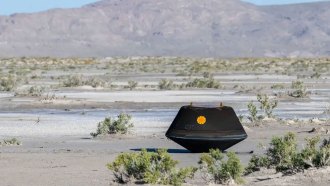
NASA’s OSIRIS-REx spacecraft brought back bits of the asteroid Bennu
Dirt from the asteroid Bennu could hold clues about the material that built our solar system — and possibly where life comes from.
- Planets
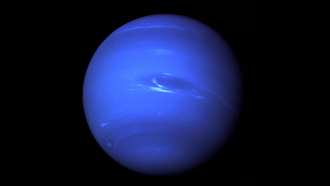
Analyze This: Neptune’s cloud cover syncs up with the solar cycle
Telescope observations hint how sunlight-driven chemistry may boost cloud cover on our solar system’s farthest planet.
- Planets
In a first, astronomers spot the aftermath of an exoplanet smashup
Infrared light from a distant star appears to be leftovers of an impact between a pair of Neptune-sized worlds.