Uncategorized
- Planets
Here’s how future Martians might take their first breaths
Mars would need an atmosphere thick enough to hold heat and with enough oxygen for people to breathe. This is how we might terraform Mars.
- Chemistry
Scientists Say: Lipid
These oily, water-repelling molecules knit together, forming the membranes that sustain life.
- Science & Society
Analyze This: Do bad childhoods make movie villains?
In DC and Marvel movies, a rough childhood doesn’t always mean that characters become villains.
- Planets
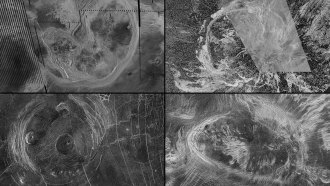
The surface of Venus is morphing
Circular landforms speckling Venus' surface may be the work of tectonics — similar to the forces that reshape Earth’s surface.
- Animals
Loss inspired this biologist to study aging
Juan Manuel Vazquez studies the anti-aging genes that have allowed some animals to evolve to live remarkably long lives.
- Health & Medicine
This medicine could help teens quit vaping
The drug varenicline, paired with counseling and text messaging support, helped young people stop vaping in a new study.
- Physics
Scientists Say: Tauonium
No protons, neutrons or electrons. And yet, based on what scientists know about fundamental particles, this variety of atom just might exist.
- Genetics
Orange cats get their ginger color from a single gene ‘cutout’
The variant gene is found on the X chromosome. This sex-linked trait for orange fur is found only in domesticated cats.
- Physics
Here’s why your blood vessels don’t burst under pressure
Cells lining the blood vessels reorganize their inner structures to handle stressful boosts in pressure.
- Space
A rogue black hole is on the loose in our galaxy
Astronomers now agree there’s a lone black hole wandering around the Milky Way — the first solitary black hole ever detected.
- Tech
Scientists Say: Prototype
These rough draft models help engineers test how a concept translates from theory to reality.
- Physics
Here’s how rainwater might one day power some of your lights
In tests, the electricity that water droplets made was small, but kept a dozen LEDs lit. This tech might one day power clean energy for wet or rainy places.