Uncategorized
- Tech
Explainer: What are lidar, radar and sonar?
Radar, sonar and lidar and are three similar technologies. Each relies on the echoing of waves — radio, sound or light waves — to detect objects.
- Brain
Twisters: Can warning people too early backfire?
If people think they have enough time to flee a tornado, they may try to drive away, information shows. This could leave them stuck in traffic — with no protection — when the storm does show up.
- Earth
Nepal earthquake offers hints of worse to come
The magnitude 7.8 earthquake that crumbled much of Nepal’s capital city could be overshadowed by larger future earthquakes along the Himalayas, scientists say.
- Fossils
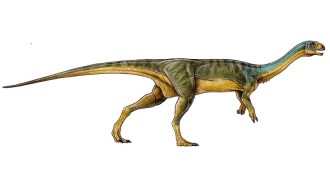
‘Frankenstein’ dino showed a mashup of traits
New species unearthed in Chile is “an anatomical Frankenstein,” declares one of its discoverers.
- Chemistry
How sweat might make you smell sweeter
A new scent-delivery system ensures that the more you sweat, the more perfume it releases. In fact, it only works in contact with moisture.
- Space
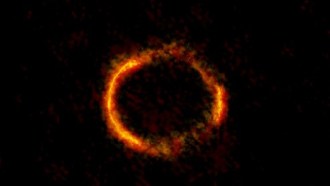
Scientists Say: Gravitational lens
A gravitational lens is an effect that occurs when a massive object lies between a viewer and something further away. The massive object’s gravity bends light arriving from the more distant object.
- Earth
News Brief: Smokin’ plants
A new study points out how some herb teas and spices could have accidentally picked up nicotine from the smokers working around them.
- Health & Medicine
News Brief: Ebola’s dead stay infectious for a week
The Ebola virus doesn’t die with its victims — at least not right away. A corpse may host live virus for up to a week after death, a new study finds.
- Materials Science
Cool Jobs: Big future for super small science
Scientists using nanotechnology grow super-small but very useful tubes with walls no more than a few carbon atoms thick. Find out why as we meet three scientists behind this huge new movement in nanoscience.
- Physics
News Brief: As timely as it gets
A newly modified atomic clock won’t lose or gain a second for 15 billion years. This timepiece is about three times more precise than an earlier version.
- Health & Medicine
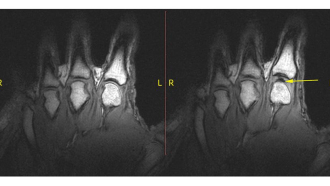
Mystery solved: Why knuckles crack
Scientists have puzzled over what makes that loud sound when our knuckles “crack.” Bubbles appear to play a role, but not in popping.
- Space
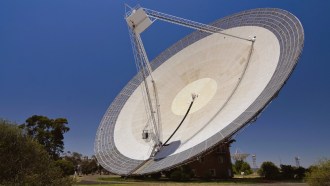
Radio telescope picks up signals from intelligent life
Astronomers tracked down the source of perytons, mysterious radio bursts. They had at first seemed to emanate from Earth’s atmosphere. Probing now suggests the life forms responsible had a penchant for leftovers.