Uncategorized
- Brain
Back off, bullies!
Mental health is another reason to stop bullies. Victims of bullying are more likely to develop anxiety problems than are victims of abuse or neglect, a new study finds.
- Health & Medicine
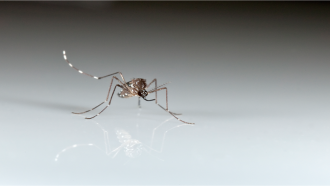
Do mosquitoes love you? Blame your parents
By studying twins, scientists found that how attractive we are to mosquitoes depends partly on our genes. That could lead to better bug repellents.
- Chemistry
Scientists Say: Ion
Some atoms and molecules have a positive or negative electrical charge. These are called ions.
- Brain
Trip to Mars could damage astronauts’ brains
Experiments in mice suggest the high-energy particles that would zap astronauts on a mission to Mars could leave the explorers with brain damage.
- Chemistry
Cool Jobs: Saving precious objects
Museum conservators are experts at protecting and restoring precious objects. Along with art or history, many also have studied chemistry, physics, archaeology or other scientific fields.
- Animals
What’s for dinner? Mom.
Female spiders of one species make the ultimate sacrifice when raising their young: The mothers feed themselves to their children.
- Climate
Warming’s role in extreme weather
Extremes in temperature and precipitation will be more common as global temperatures rise. Human-led climate change is largely to blame, a new study finds.
- Climate
Cosmic rays offer clues about lightning
Space particles called cosmic rays pelt Earth. Scientists are using the rain of these particles to probe how lightning forms.
- Health & Medicine
Injected nanoparticles treat internal wounds
Soldiers wounded in a bombing could be treated with a shot of specially designed nanoparticles that stop bleeding and inflammation in the lungs.
- Environment
Scientists Say: Fracking
Liquid fuel sources such as natural gas and petroleum form deep underground between layers of rock. To retrieve them, engineers often use a technique called hydraulic fracturing, or fracking.
- Fossils
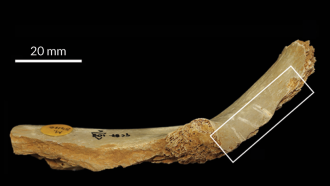
Ritual cannibalism occurred in Stone Age England
Stone Age human bones from a cave in England show signs of cannibalism. The people had been eaten during burial rituals nearly 15,000 years ago, experts say.
- Archaeology
Laser vision reveals hidden worlds
From discovering ancient ruins to forecasting climate change, the laser mapping technology called lidar is changing many fields of science.