Songs prep unhatched finches’ brains for a hot world
Hearing parents’ 'heat calls' in the egg makes chicks more resilient to heat after hatching
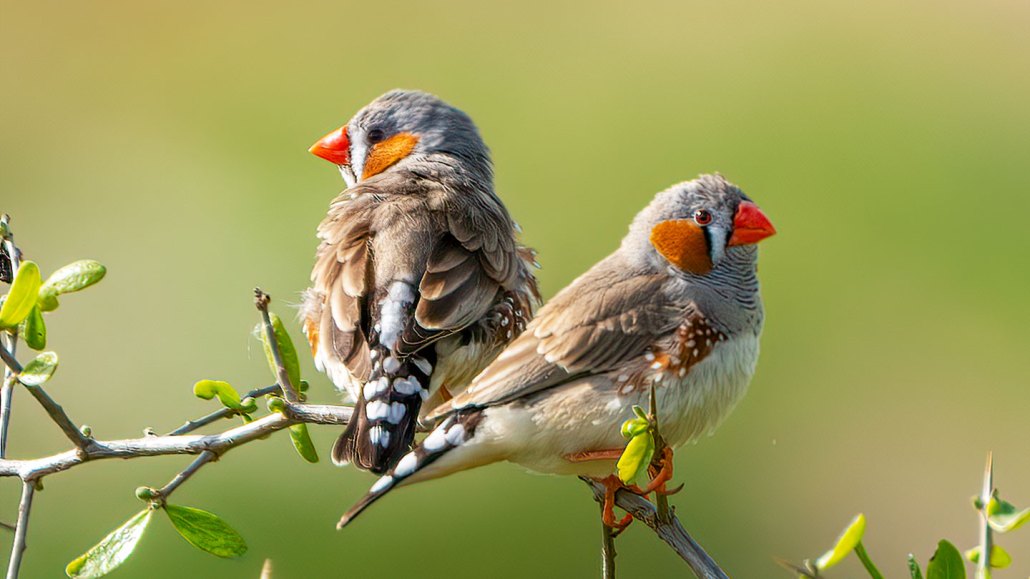
Australian zebra finches (shown) make rapid peeps when the temperature rises. These “heat calls” reprogram their babies’ brains in preparation for the heat, even before they leave the egg.
David Cook/flickr (CC BY-NC 2.0)
Share this:
- Share via email (Opens in new window) Email
- Share on Facebook (Opens in new window) Facebook
- Share on X (Opens in new window) X
- Share on Pinterest (Opens in new window) Pinterest
- Share on Reddit (Opens in new window) Reddit
- Share to Google Classroom (Opens in new window) Google Classroom
- Print (Opens in new window) Print
By Jake Buehler
This is a human-written story voiced by AI. Got feedback? Take our survey . (See our AI policy here .)
Like many parents, zebra finches sing to their young. But some parental songs seem to prepare the baby birds for hot weather, even before they leave the egg.
Zebra finches live in sun-crisped Australian woodlands. On hot days, adults make a rapid, peeping “heat call.” It kicks off genetic changes in the brains of their unhatched babies. The tune acts like a weather forecast. It prepares them for the broiling conditions on the outside of the eggshell.
Researchers described their new findings June 11 in the Journal of Experimental Biology.
A decade ago, behavioral ecologist Mylene Mariette was part of a team that made a discovery. Exposure to heat calls in the egg, shortly before hatching, changed how chicks of these zebra finches (Taeniopygia guttata) dealt with high temperatures. They grew more slowly. They also preferred warmer places to nest. In all, they seemed better able to handle heat.
But one mystery remained: How could hearing a simple song trigger all this?
Singin’ for the brain
Mariette, of Deakin University in Waurn Ponds, Australia, teamed up with neuroscientist Julia George. George works at Clemson University in South Carolina. The pair wanted to know if those songs might trigger changes in the brain’s hypothalamus. This region plays a big role in controlling the birds’ metabolism and responses to heat.
Hear the finch’s heat-induced call
This high-pitched, rapid peeping is the “heat call” of Australian zebra finches. It spurs their unhatched babies’ brains to change how they move blood around. This might reduce the hatchlings’ risk of heat stroke — and lasts the birds’ entire life.
“Some of the consequences of [the call] are permanent. The birds will choose warmer nest sites as adults if they are exposed to heat calls as embryos,” says study author Julia George. “And they will produce more offspring in those warmer environments.”
The researchers raised the eggs of zebra finches at a consistent temperature. Then they separated them into two groups. They exposed about half of these eggs to playbacks of an adult’s heat call. The other half heard a different call for a few days. Afterward, the team removed the embryos from the eggs and euthanized them.
Researchers cut out a small sample of the hypothalamus and extracted some of its RNA. This is a messenger molecule made based on DNA. It carries genetic information to the protein-making parts of the cell. The researchers planned to compare the levels of different RNAs. This should show how certain genes ramp up or down.
The team expected the heat calls would trigger changes in hormone-regulating genes, George recalls. Instead, the songs reduced the activity of genes that control how the brain’s blood vessels squeeze. The researchers now think this helps the chicks brains’ shed heat.
“It’s important that the temperature of the brain is kept cool, even in hot temperatures,” George says. Modifying blood flow there could protect against dangers such as heat stroke.
The calls didn’t change how the hypothalamus works, in general. Instead, only a select set of systems in it seemed to change. These systems are vulnerable to high temperatures. Only about 2 percent of the RNA in the hypothalamus showed this response to the heat calls.
The heat calls could be “like a little weather forecast,” George says, that allows finches to fine-tune their brain’s development. And this might leave them “better suited to the environment right after they hatch,” she adds.
Ready for a warmer world
Other types of yet-to-hatch birds have also shown sound-triggered changes. Yellow-legged gulls warn each other of predators. Those exposed in the egg to these warning calls grew more slowly. After hatching, they also were more likely to crouch when they heard those calls.
Alexandra Cones wonders if there are other genetic and cellular ways for animals to adapt to heat. Cones is an evolutionary behavioral ecologist at Ludwig Maximilian University. It’s in Munich, Germany. She did not take part in the new finch study. But her own research has shown that adult house sparrows can change how their chicks’ metabolisms respond to temperature.
Cones’s team never uncovered exactly how this happens. But, she says, the zebra finch data “forces us to consider a broader range” of possibilities for how such a flexibility evolved.
Zebra finches may not be alone in their brain-bending musical abilities, George concludes. Perhaps there’s a whole playlist of heat-busting birdsongs yet to be discovered.
Do you have a science question? We can help!
Submit your question here, and we might answer it an upcoming issue of Science News Explores