Explainer: What is an equation?
A mathematical statement, it tells us two expressions are in balance, or equal

There are several ways to write a multiplication problem. This young girl is attempting to answer one that has been displayed linearly — as an equation.
PeopleImages/iStock/Getty Images Plus
This is a human-written story voiced by AI. Got feedback? Take our survey . (See our AI policy here .)
An equation is a mathematical statement that’s written linearly — in a straight line. It has two parts separated by an equal sign (=). And as that sign would suggest, what appears on either side of it has the exact same value.

Math statements weren’t always written this way. Even today, grade-school kids learn to write these statements vertically — with numbers above and below a straight line. That line corresponds to the equal sign. For instance:

One might be tempted to think that equations as we know them are as old as math. But no. Math goes back millennia. The symbols used in equations are relatively recent.
Centuries ago, “math used to be written out” in words, notes British mathematician Robin Wilson. “They call it rhetorical algebra.” A math historian, he authored the 2025 book, Sum Stories: Equations and Their Origins. People used to use regular words to express additions, subtractions and other relationships between numbers and the things they were counting.
For instance, someone might have written: “Ship one brought two hundred fish to port. Fifty were flounder, seventy-five were bream, twenty-seven were sharks and forty-eight were anchovies.” Now it might be shortened to 50 flounder + 75 bream + 27 sharks + 48 anchovies = 200 fish.
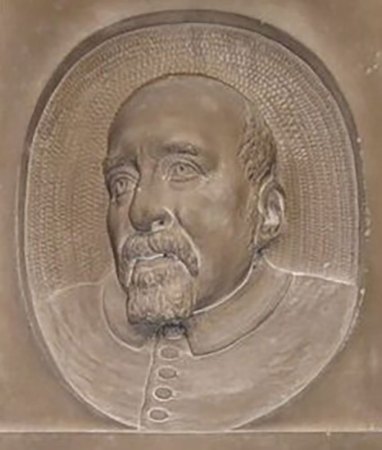
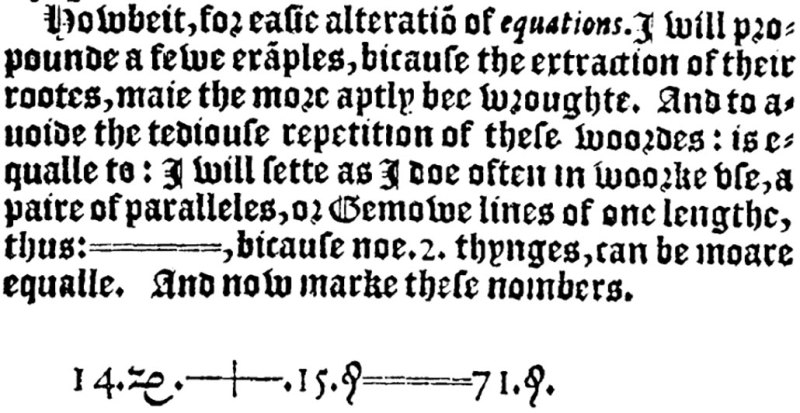
But that shortened version couldn’t have been written before 1557. That’s when the equal sign made its world debut in The Whetstone of Witte. (This math book’s name literally means sharpening your wits). Its author was Welsh mathematician Robert Recorde.
Among many things in this tome, Recorde introduces that equal symbol so he can avoid having to tediously repeat the words “is equal to.” Why choose two horizontal lines of the same length? Because, he argued, no two things can be more equal. (Of course, he said it a bit differently, as he was writing it in a very early version of modern English.)
That equal sign was a relative latecomer among our familiar math symbols. People started using the plus (+) and minus (-) signs around the late 1300s and early 1400s.
And the equation at the start of this piece would have made no sense before 1631. That’s when William Oughtred, a 17th-century English math expert, introduced the “x” mark for multiplication (in his book Clavis Mathematicae).
About that equal sign
“The equal sign is quite interesting and is slightly different from an operator like plus, minus, divide or multiply,” says Clemency Montelle. She’s a math historian at the University of Canterbury, New Zealand. The equal sign, she notes, “is not saying calculate anything. But it is indicating a relationship: that one thing on one side is identical [to the other side].”
And that’s true, she notes, “even if they don’t look the same.”
In 4+1 = 5, the two digits on the left-hand side don’t look identical to the digit on the right. Still, they have the exact same value. Montelle finds this quite a “powerful” idea.
“Equations are a way of expressing what you’re doing accurately, precisely and efficiently,” Wilson adds. The “=” signifies a balance — like on a scale — between the quantities on the left and right sides.
The power of balance
Knowing that there’s a balance between the mathematical expressions on either side of an equal sign allows us to solve for something in that expression that may be unknown. This is the basis of algebra, an especially useful branch of math.
Suppose we know that Daniel and Alice picked 9 apples from their backyard tree. We know that Daniel has 5 apples. Given this information, we can calculate how many Alice has. It can be written as this hybrid word problem:

By subtracting 5 from each side, we can calculate that the unknown quantity — the number of apples Alice has — must be 4.
Here the unknown quantity was apples. But it could be anything. Mathematicians generally refer to such an unknown with a letter. Often it’s an “x”.
Earlier in history, some cultures used other approaches. The ancient Indians, for instance, used word abbreviations for various colors to represent some unknown values. Ancient Mesopotamians used different words that meant such things as length, width and area to denote some unknowns.
Being able to calculate an unknown number makes equations widely useful.
Before equations existed, ancient astronomers painstakingly developed tables of numbers. Think of multiplication tables, with the numbers to be multiplied in the first row and column and the products of those multiplications filling in the rest of the table. This allows anyone to read out the answer for any product quickly.
Similarly, astronomers used tables to track a planet’s motion, observe phases of the moon and predict eclipses. If they wanted to follow a planet’s motion, they’d go down the table to the day and look across to read the number. Such a table could span weeks, months or even years. Creating them took painstaking amounts of mathematical effort.
Do you have a science question? We can help!
Submit your question here, and we might answer it an upcoming issue of Science News Explores
Equations offer a compact substitute for such tables. Each equation describes the relationship between features of interest, such as a planet’s motion over time. To use it, you input the known values into the equation. For instance, this might be the date and the planet’s position. Then by performing the operations in that equation, you can calculate some unknown value, such as the distance traveled by the planet.
“Equations might seem rather dry,” says Montelle. “But they reveal a hidden structure or numerical pattern that we would otherwise have to write out one by one by one.”
That’s why behind the scenes, equations now play important roles throughout society.
They help engineers design and construct safer buildings. They can let airline pilots calculate how much fuel they’ll need if they know the distance they’re traveling and average speed they’ll be flying. And suppose you have a cake recipe that calls for 2.75 cups of flour. You could use an equation to scale up or down the ingredients needed to make one that’s two and a half times as big or just a mini-cake one-quarter the normal size.