A geometric pattern lurks in Chinese money plant leaves
Tiny pores in the leaves may shape veins into a surprising mathematical design

Here, light filters through the leaves of a Chinese money plant. You can see a mosaic of veins and pores that form a mathematical pattern called a Voronoi diagram.
Nick Wurm/CSHL
This is a human-written story voiced by AI. Got feedback? Take our survey . (See our AI policy here .)
A common houseplant hides a splendid geometric pattern.
This design, called a Voronoi diagram, appears on the leaves of the Chinese money plant. The layout may arise as waves of a plant hormone spread across a leaf during its development. A similar process may shape the vein patterns in leaves of other plants, too.
Researchers shared these findings May 12 in Nature Communications.
This is a “beautiful” showcase of how plant veins develop to move water across leaves most efficiently, says Lawren Sack. He did not take part in the research. But he does study plant biology at the University of California, Los Angeles. Veins of leaves “have so much to tell us” about how to get resources where they need to go, he says.
Lurking in leaves
Leaves of the Chinese money plant (Pilea peperomioides) are speckled with pores. Called hydathodes, these pores release water. Each one is fenced in by veins to form a mosaic.
While in high school, Elijah Blum discovered a curious pattern in those leaf veins. He noticed it while plant-sitting for his sister. At the time, Blum was an intern at Cold Spring Harbor Laboratory in New York. (He’s now in college at New York University.) He shared what he’d found with his internship supervisor, computer scientist Saket Navlakha.
“He showed the plant to me, and he said, ‘Look, the veins look kind of interesting here,’” Navlakha says. “We sort of held it up to the light — and we saw that … Voronoi diagram.”
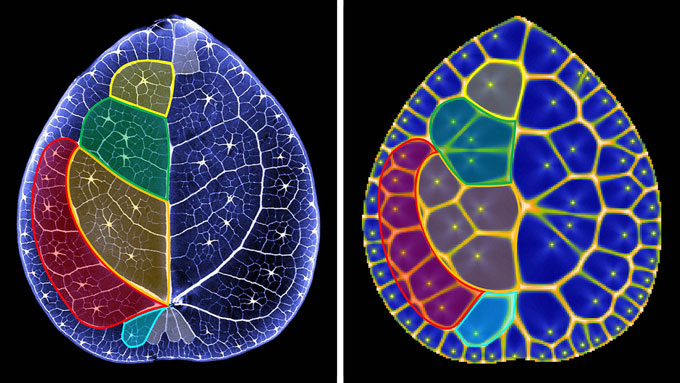
In a Voronoi diagram, a surface is split up into zones. Each zone contains a designated point. And every spot within a zone must be closer to that zone’s point than any other.
Urban planners use the same idea to decide which fire department a house should be assigned to. This helps each house in a city or town be closer to the fire station in its zone than any other station.
Patterns that look similar to Voronoi diagrams appear elsewhere in nature. The tiles on giraffe fur look like this type of design. So do the scales of dragonfly wings. But in a true Voronoi diagram, the mosaic must form around a set of points. In the Chinese money plant, the water-oozing pores serve as those points.
Making the mosaic
Blum and the others were curious how this pattern might develop.
Similar leaf veins are thought to form through canalization. In this process, a hormone involved in plant development — auxin — branches out across leaves. As it does, it creates a treelike network of channels that become veins.
But that wouldn’t produce a Voronoi diagram around a leaf’s pores, the team found. Computer models instead showed that as Pilea leaves develop, waves of auxin spread out from each pore. Those waves collide to form ridges. Eventually, they become a leaf’s major veins.
More research is needed to find out why Pilea leaves follow this pattern, says team member CiCi Zheng. She studies the math of living things at the Allen Institute in Seattle, Wash.
The Voronoi diagram layout might be useful for plants, she says. This pattern keeps a leaf’s major veins — which transport water — as far as possible from its water-leaking pores. “You might want to place the veins not directly close to any of those locations where water evaporates super-fast,” Zheng says.
Sack at UCLA is excited about what new tech this finding might inspire. Past studies of leaf veins, he says, have helped engineers reimagine how to distribute resources such as water and energy. Such insights have improved solar panels, electronic circuits and irrigation systems.
“The more we know about leaf veins,” Sack says, “the more we can build functional and beautiful systems around us.”
Do you have a science question? We can help!
Submit your question here, and we might answer it an upcoming issue of Science News Explores