Engineering Design
- Materials Science
New twist can hush — even cloak — some sounds
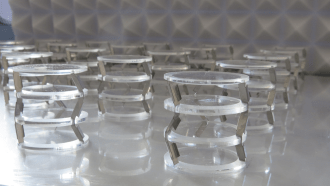
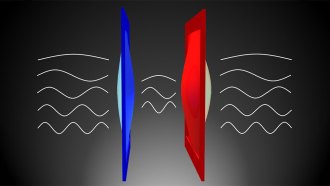
Swiss engineers developed clear, spiral structures to make a new sound-dampening system. Those twists block some vibrations and lets others through.
- Animals
Drones might one day capture a dolphin’s breath in midair
High-speed footage of dolphin spray reveals that droplets blast upward at speeds close to 100 kilometers per hour.
- Math
Color-changing fibers help unravel a knotty problem
Experiments with colorful fibers helped scientists discover a few simple rules on why the strength of various types of knots differs.
- Health & Medicine
Your most urgent questions about the new coronavirus
Researchers have more questions than answers right now about 2019-nCoV. They’re racing to understand and stop the coronavirus and the health crisis it poses.
- Chemistry
Help for a world drowning in microplastics
Microplastic pollution in our oceans and lakes is a problem. Scientists are testing solutions — from more biodegradable recipes to nanotechnology.
- Materials Science
Here’s how to hide some objects from heat-sensing cameras
A special coating that conceals temperature information from heat-detecting cameras might someday be used as a privacy shield.
- Science & Society
A first: Kids advise hospital researchers on their medical studies
When the Mayo Clinic realized it was missing key voices, the hospital recruited kids to advise doctors about their research.
- Materials Science
Self-powered surface may evaluate table-tennis play
Scientists at the Georgia Institute of Technology built a 'smart' surface on which to play table tennis. It can track the location, speed and direction of the ball.
- Physics
Giving Notre Dame back her unique voice
A 2019 fire robbed Paris’ Notre Dame cathedral of more than her roof. She also lost her voice. Now scientists are using acoustics to return her unique soundscape.
- Physics
Here’s how quantum mechanics lets heat cross a vacuum
Heat can move across a vacuum if the span is small enough. As in really, really small. In a new experiment, the gap was only a few hundred nanometers.
- Health & Medicine
Viewing virtual reality of icy landscapes may relieve pain
Traveling to polar vistas via virtual reality eased a temporary burning in the viewers’ skin. The same VR also lessened simulated chronic pain.
- Computing
How math makes movies like Doctor Strange so otherworldly
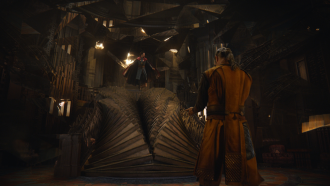
In the 1970s, a mathematician introduced geometric patterns that he named fractals. Moviemakers are now using those patterns to create dazzling digital effects.