HS-PS4-1
Use mathematical representations to support a claim regarding relationships among the frequency, wavelength, and speed of waves traveling in various media.
- Physics
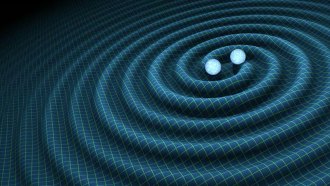
Gravity waves detected at last!
Albert Einstein predicted gravitational waves 100 years ago. Now scientists have detected them coming from the collision of two black holes.
- Physics
Explainer: What are gravitational waves?
Albert Einstein had predicted that large catastrophes, like colliding black holes, should produce tiny ripples in the fabric of space. In 2016, scientists reported finally detecting them
- Physics
How to catch a gravity wave
Physicists have just announced finding gravity waves. The phenomenon was predicted a century ago by Einstein’s theory of general relativity. Here’s what it took to detect the waves.
- Earth
News Brief: Why rainbows can lose some hues
When the sun is right near the horizon, such as at sunset, its light travels through the most atmosphere. When there’s also plenty of water in the air, this can rob colors from a rainbow, scientists now report.
- Earth
Ground-thumping cheers help scientists
Eager to test new sensors before the next ‘big one,’ earthquake scientists make use of a predictable source of ground-shaking: football fans.
- Tech
Making cents of sounds
Some people give up when a vending machine rejects their money. But one student decided to turn his frustration into inspiration. Through research, he showed how to identify coins by the sounds they make.
- Chemistry
Cool Jobs: Saving precious objects
Museum conservators are experts at protecting and restoring precious objects. Along with art or history, many also have studied chemistry, physics, archaeology or other scientific fields.
- Archaeology
Laser vision reveals hidden worlds
From discovering ancient ruins to forecasting climate change, the laser mapping technology called lidar is changing many fields of science.
- Tech
Explainer: What are lidar, radar and sonar?
Radar, sonar and lidar and are three similar technologies. Each relies on the echoing of waves — radio, sound or light waves — to detect objects.
- Earth
Nepal earthquake offers hints of worse to come
The magnitude 7.8 earthquake that crumbled much of Nepal’s capital city could be overshadowed by larger future earthquakes along the Himalayas, scientists say.
- Space
Scientists Say: Gravitational lens
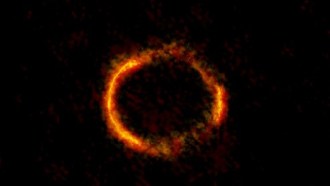
A gravitational lens is an effect that occurs when a massive object lies between a viewer and something further away. The massive object’s gravity bends light arriving from the more distant object.
- Space
Radio telescope picks up signals from intelligent life
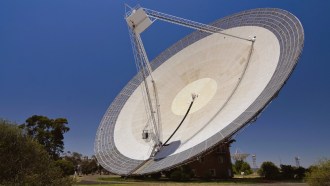
Astronomers tracked down the source of perytons, mysterious radio bursts. They had at first seemed to emanate from Earth’s atmosphere. Probing now suggests the life forms responsible had a penchant for leftovers.