MS-ESS1-2
Develop and use a model to describe the role of gravity in the motions within galaxies and the solar system.
- Space
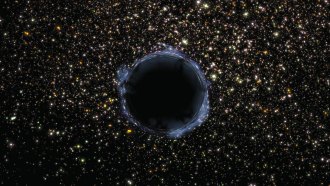
Ancient black holes might solve the mystery of dark matter
Studies of gravitational waves, stars and other features of the universe could reveal whether such “primordial” black holes exist.
- Space
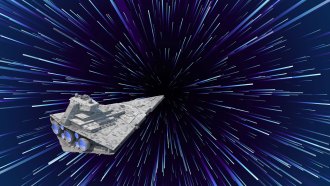
Spacecraft need an extra boost to travel between stars
Star Wars makes space travel look easy by breaking the laws of physics. Off-screen, the technology for spacecraft to reach other worlds doesn’t exist yet.
- Space
Comets may be the source of sandy dunes on Saturn’s largest moon
In an early reshuffling of the solar system, comet collisions and other space rocks could have sent dusty bits falling to Titan’s surface.
- Space
Check out the magnetic fields around our galaxy’s central black hole
Astronomers have captured polarized light coming from the Milky Way’s supermassive black hole. This offers insight into its magnetic fields.
- Space
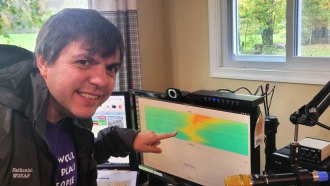
This space physicist uses radios to study eclipses
Nathaniel Frissell uses radio data to study how eclipses affect a layer of the atmosphere called the ionosphere.
- Planets
Huge polygons on Mars hint its equator may once have been frozen
A Chinese rover used radar to reveal long-buried terrain. The discovery hints that Mars’ equator was once much colder and wetter.
- Chemistry
Pollution power? A new device turns carbon dioxide into fuel
Scientists made a device that converts the greenhouse gas into formate. This salt can then run a fuel cell to make electricity.
- Planets
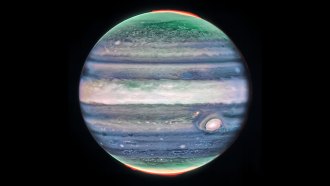
Jupiter has a never-before-seen jet stream — and it’s speedy
Spotted in images from the James Webb telescope, the high-altitude current may help untangle the workings of the giant planet’s atmosphere.
- Planets
In a first, astronomers spot the aftermath of an exoplanet smashup
Infrared light from a distant star appears to be leftovers of an impact between a pair of Neptune-sized worlds.
- Space
You can get involved in science during the 2024 solar eclipse
The sun will be near the peak of its activity cycle during the eclipse on April 8, 2024. That will make it a great time to crowdsource solar research.
- Space
Weird black holes may reveal secrets of the early universe
Emerging evidence points to the existence of rogue black holes and other cosmic oddities — such as big black holes in tiny galaxies.
- Space
Newfound gravitational waves may be from the biggest black holes in the universe
Observations of dead stars hint that ripples in spacetime — ripples light-years long — roll through our universe.