MS-PS2-4
Construct and present arguments using evidence to support the claim that gravitational interactions are attractive and depend on the masses of interacting objects.
- Tech
A new device uses atoms’ quantum weirdness to peer underground
Quantum sensors like this one could monitor magma beneath volcanoes or uncover archaeological artifacts.
- Physics
Explainer: How do mass and weight differ?
Learn why these terms aren’t the same and which to use where. And should you report your results in kilograms? Pounds? If in doubt, try using newtons.
- Tech
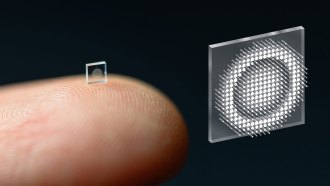
This crumb-sized camera uses artificial intelligence to get big results
Researchers have developed a camera the size of a coarse grain of salt that takes amazingly clear photos.
- Physics
Scientists Say: Mass
Mass shows how much an object resists speeding up or slowing down when force is applied — a measure of how much matter is in it.
- Physics
Staying grounded in space requires artificial gravity
On TV, people in space walk around like they’re on Earth. How can science give real astronauts artificial gravity? Spin right round, baby.
- Earth
Light levitation might help explore Earth’s ‘ignorosphere’
A toy called a light mill inspired researchers to invent a new way to fly. They’re using light to levitate small nanotube-coated discs.
- Physics
NASA’s Parker probe spots rogue waves and magnetic islands on the sun
The Parker probe’s first data is giving scientists a look at what’s to come as the craft moves closer to the sun over the next few years.
- Physics
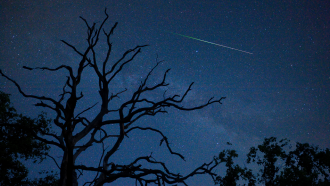
Explainer: Understanding meteors and meteor showers
Meteors regularly enter Earth’s atmosphere. Most ‘shooting stars’ pose few risks to life on the ground, but the rare big ones can be lethal.
- Earth
Falling through Earth might be a long and fruitless trip
A classic physics problem asks what would happen if you plunged through Earth’s center. A new study contends you could never make it to the other side.
- Planets
Juno’s knocking on Jupiter’s door
The Juno spacecraft will peer into Jupiter’s clouds and fly in close to its monstrous auroras.
- Chemistry
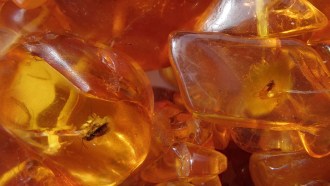
Identifying ancient trees from their amber
A Swedish teen’s analyses of a sample of amber may have uncovered a previously unknown type of ancient tree.
- Physics
Einstein taught us: It’s all ‘relative’
One hundred years ago, a German physicist shared some math he had been working on. In short order, his theory of relativity would revise forever how people viewed the universe.