MS-PS4-1
Use mathematical representations to describe a simple model for waves that includes how the amplitude of a wave is related to the energy in a wave.
- Physics
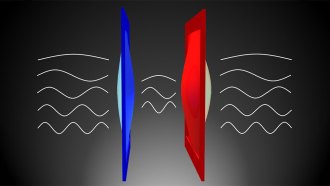
Here’s how quantum mechanics lets heat cross a vacuum
Heat can move across a vacuum if the span is small enough. As in really, really small. In a new experiment, the gap was only a few hundred nanometers.
- Archaeology
Ancient Egyptian mummy tattoos come to light
A range of markings discovered on female mummies are challenging ideas about tattoo traditions in ancient Egypt.
- Health & Medicine
Explainer: What is ultrasound?
These sound waves, which fall above the range of human hearing, are important in medicine, medical imaging and more.
- Science & Society
Heating up the search for hidden weapons
Using an off-the-shelf camera and an innovative bit of software, a high-school student developed the means to inexpensively detect a hidden weapon.
- Earth
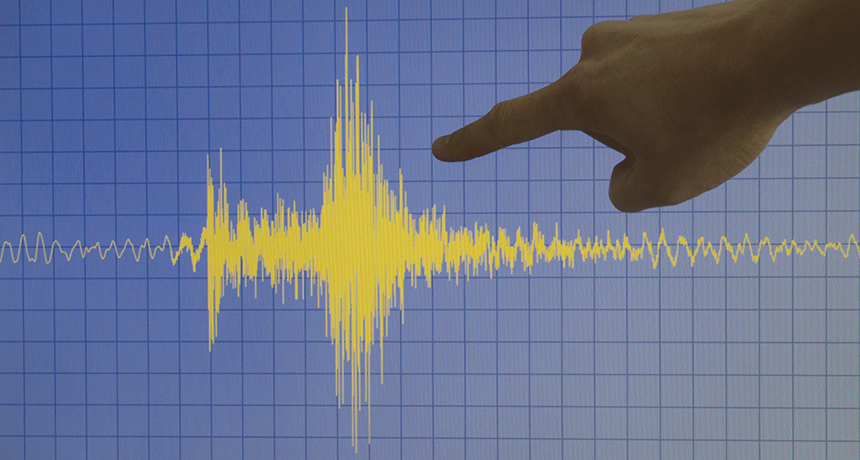
Explainer: Seismic waves come in different ‘flavors’
Earthquakes generate several different types of seismic waves, some more damaging than others
- Physics
Disabilities don’t stop these experts in science and tech
People with disabilities are as varied as the careers some of them pursue in science, technology, engineering and math.
- Health & Medicine
Scientists Say: Acoustic
Acoustic is an adjective used to describe something involving sound. It’s also a noun that refers to the branch of physics that studies sound.
- Physics
Strange X-rays point to possible ‘dark’ matter
Scientists have been looking for “dark” matter. It’s supposed to make up most of the universe — but it’s also invisible. X-rays may now point to where some of this weird stuff is.
- Physics
Explainer: How heat moves
Energy moves through the universe one of three ways: conduction, convection and radiation. Only radiation can occur through empty space.
- Physics
Spinning black holes may ‘sing’ during a collision
The massive black hole in the movie Interstellar would create a unique gravity-wave signal when gobbling a smaller partner.
- Brain
Headed to a concert this summer? Pack earplugs
Wearing earplugs at concerts and other loud events may prevent hearing loss and permanent ear damage, a new study suggests.
- Brain
Explainer: When loud becomes dangerous
Many people don’t realize that sounds — even those of the music they love — can prove harmful when they get too loud.