Physics
- Physics
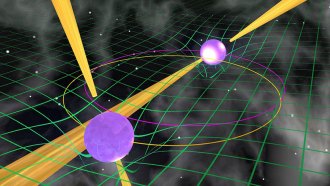
Zombie stars: A source of gravitational waves?
Scientists have found indirect evidence that the dense cores of dead stars are making ripples in space, known as gravitational waves. These waves have been predicted but never yet directly “seen.”
- Animals
Some fish wear an invisibility cloak
Some fish can hide in open water. How? Tiny crystals in their scales and skin help them reflect and blend in with polarized light.
- Environment
Engineers consider liquid salt to generate power
A new type of power plant, a molten salt reactor, might provide electricity in a cleaner and safer way than current nuclear technology.
- Ecosystems
Two SNS writers win big
Here’s a Cool Job: writing about science. Two people who regularly do that for SNS have just picked up awards for stories on the physics of lightning and how nature recycles the dead to feed the living.
- Physics
Explainer: Locating a gun with sound waves
Recording the sound of a gun from three microphones can help scientists pinpoint the weapon’s location.
- Physics
Boom! Sounding out the enemy
Armistice Day marked the end of the Great War. But what arguably won the war was acoustics — the science of sound. It allowed Allied troops to home in on and rout the enemy.
- Chemistry
Explainer: Temperature and electrical resistance
Higher temperatures mean more energy and more motion. In contrast, cold means slow moving molecules.
- Health & Medicine
Light can control waves in heart tissue
Researchers have used light to trigger and control electrical waves in the heart. The technique might one day provide new ways to treat heart disease.
- Physics
Einstein taught us: It’s all ‘relative’
One hundred years ago, a German physicist shared some math he had been working on. In short order, his theory of relativity would revise forever how people viewed the universe.
- Physics
Particles that zip through matter snare Nobel
Two scientists won the 2015 Nobel Prize in physics for their discovery that neutrinos, particles that can pass through almost all matter, have mass.
- Materials Science
Scientists Say: Kevlar
Many people hear Kevlar and think of body armor. But this polymer is in so much more.
- Animals
Hummingbird tongues may be tiny pumps
Scientists had thought that hummingbird tongues work through capillary action. A new study, though, concludes they work like little pumps.